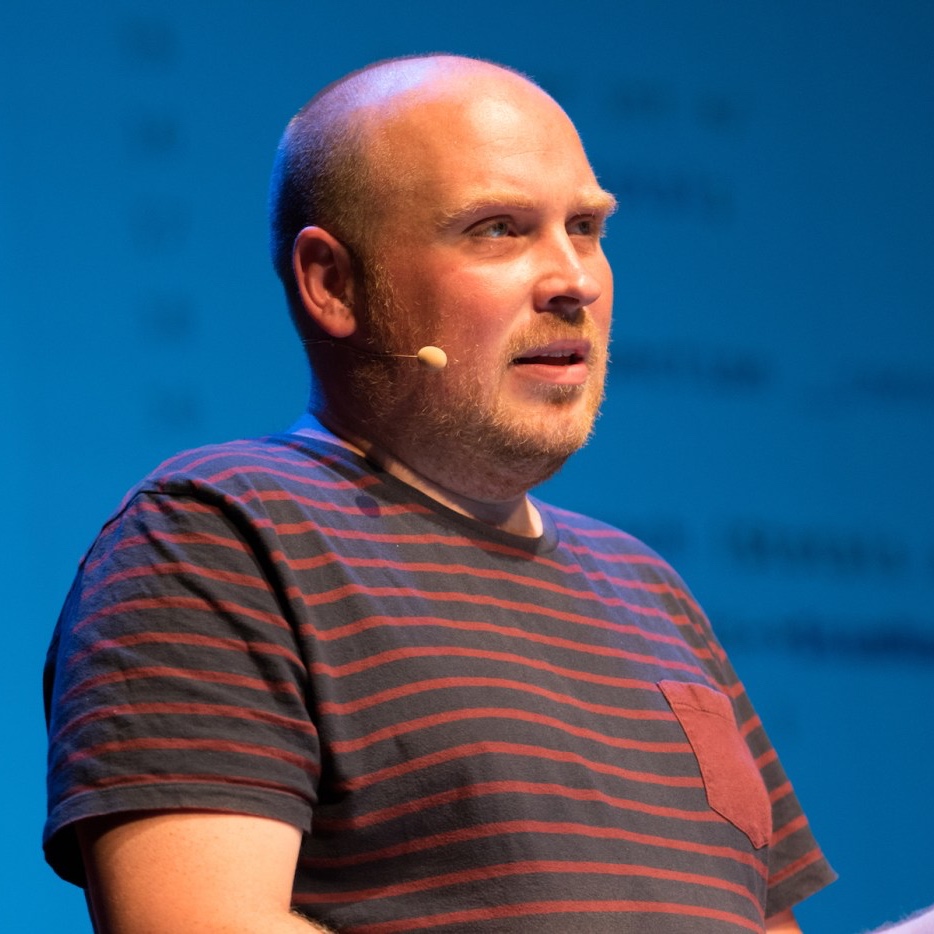
Here's another awesome blogpost by my collegue Seb. In this one he explains why you should and how you can create an explicit Vue component API.
When refactoring your UI to components, always keep in mind that props and events are your components public API. Just like when you're modelling your application's domain, try to keep things explicit. Props and events should be enough to tell the outside world everything it needs to know about a component's behavior.
Here are some good reasons why you shouldn't use a first name and last name field.
The structure of a name is not the same across cultures. Users who visit your site will consist of a broad range of people from different countries. Your name field should be culturally inclusive so that no one struggles to fill out your form. With most things in life two is better than one. But when it comes to name fields one is better than two.
Get my monthly newsletter with what I learn from running Spatie, building Oh Dear, and maintaining 300+ open source packages. Practical takes on Laravel, PHP, and AI that you can actually use.
No spam. Unsubscribe anytime.
You can also follow me on X.
"Freek’s newsletter is one of the best ways to stay updated with the Laravel and PHP ecosystem. It consistently highlights useful packages, tools, and ideas from the community, especially the amazing work coming from Spatie. As a Laravel developer building SaaS and web platforms, I find it extremely helpful to discover practical tools and insights that improve my development workflow."
Ross Tuck makes the case that not all code is equal.
Most teams follow the Broken Window Theory, fearing even a single tradeoff starts the slide down a slippery slope. This can reduce discussion (read: dissension) in the short term but leads to arbitrary compliance or worse. ... Deciding on a level of quality isn’t like deciding on a coding standard, you can’t have an off-the-shelf-always-okay answer. Quality is the place to have nuanced discussions.
In another cool blogpost, Matthias Noback explains a few best practices around newing up objects, illustrated with some great examples.
Consider the following rule: "When you create an object, it should be complete, consistent and valid in one go." It is derived from the more general principle that it should not be possible for an object to exist in an inconsistent state. I think this is a very important rule, one that will gradually lead everyone from the swamps of those dreaded "anemic" domain models. However, the question still remains: what does all of this mean?
EditorConfig helps developers define and maintain consistent coding styles between different editors and IDEs. The EditorConfig project consists of a file format for defining coding styles and a collection of text editor plugins that enable editors to read the file format and adhere to defined styles. EditorConfig files are easily readable and they work nicely with version control systems.
Mattias Noback shares how you can migrate a code base that fetches its dependencies using static method calls to code that uses dependency injection.
I've worked with several code bases that were littered with calls to Zend_Registry::get(), sfContext::getInstance(), etc. to fetch a dependency when needed. I'm a little afraid to mention façades here, but they also belong in this list. The point of this article is not to bash a certain framework (they are all lovely), but to show how to get rid of these "centralized dependency managers" when you need to.
? Super simple clean-up, but the cause of so much "dead code". When using `return` statements within a `switch` block the `break` is unnecessary and is always unnecessary for the `default` case. pic.twitter.com/QxjFmiGcYy
Marina Posniak, UX writer at Spotify, shares some great tips on how to write error messages well.
To start, ask yourself if you even need the error message. Before writing anything, consider if there’s a way to redesign the experience so there’s no error at all. Is there a way to just make it work? (Really, the best error message is no error message.)
But if you do need it, think carefully about the message. When things go wrong and the app “fails,” say something useful. The message should help the user solve the problem and move on.
Rémi Collin shares a cool approach on where to place code that doesn't really belong in a controller. He creates small, reusable, testable, decoratable classes, called Actions.
Using this approach can seems a lot of classes at first. And, of course the user registration is a simple example aimed to keep the reading short and clear. Real value starts to become clear once the complexity starts growing, because you know your code is in one place, and the boundaries are clearly defined.
In a new video Jason McCreary, the creator of the wonderful Laravel Shift, demonstrates a few good tips to clean up code. In the video below Jason uses a code snippet taken from my side project Oh Dear!
John Bonaccorsi, a developer from Tighten, wrote some good ways of structuring model factories in a Laravel app.
Thanks to class-based model factories, our test setup went from being a bloated mess to simple and succinct. The optional fluent methods give us flexibility and make it obvious when we are intentionally changing our world. Should you read this blog post and immediately go and update all of your model factories to be class-based instead? Of course not! But if you begin to notice your tests feeling top heavy, class-based model factories may be the tool to reach for.
Sebastian De Deyne, package creator and JavaScript wizard at Spatie, gives some good tips on how to report an issue well.
Maintaining a number of open source projects comes with a number of issues. Reporting a good issue will result in a more engaged approach from project maintainers. Don't forget: there's a human behind every project.
In an older, but still very interesting article, Mattias Verraes has some interesting thoughts on form, command and model validation.
Many of the frameworks I’ve worked with, promise to separate responsibilities with MVC. In practice, they end up coupling everything to everything. The forms are coupled to the models, and there’s a grand unified validation layer. This may be convenient at first, but it breaks down for larger systems, and creates headaches when having to support multiple clients. My approach is to clearly separate the validation for the form itself, from the Command validation and the model validation.
Mattias Noback gives some good tips for refactoring legacy code.
"Combing" legacy code by untangling the strings is a good way to improve it and take back control over it. In existing legacy code, you should stop (re)using existing methods, making them ever more generic. Instead, you create new methods, and copy code from existing ones, allowing you to simplify this copied code and end up with a manageable class.
It took me a couple of months to get this to a working state, so I hope that I'm able to save you some time should you find yourself in my shoes at some point in the future!
If you find yourself having a bunch of slow tests that don't need to execute every time you run the tests, take a look at PHPUnit's defaultTestSuite setting. TJ Miller explains it in a blog post he wrote last year.
To avoid running the interactive test suite with the rest of my tests, manually or via a CI job, I had to explicitly include all the other suites using phpunit --testsuite Api,Feature,Unit. This felt a bit grim and I would rather exclude just that one suite. So I did some digging and found the defaultTestSuite configuration for phpunit.
#30daysWithEloquent customize relations on your models as necessary in your domain. Don't be afraid to add more relations that describe your logic better.
Here's a video of a great talk by Sandi Metz she gave at RailConf 2015.
Our code is full of hidden assumptions, things that seem like nothing, secrets that we did not name and thus cannot see. These secrets represent missing concepts and this talk shows you how to expose those concepts with code that is easy to understand, change and extend. Being explicit about hidden ideas makes your code simpler, your apps clearer and your life better. Even very small ideas matter. Everything, even nothing, is something.