How to clean up your local git branches
– tomschlick.com – Edit
What happens to all of those local branches after the pull request has been merged and deleted on Github?
Read more [tomschlick.com]
– tomschlick.com – Edit
What happens to all of those local branches after the pull request has been merged and deleted on Github?
Read more [tomschlick.com]
– mattstauffer.com – Edit
Matt Stauffer shows a good workflow for this.
Read more [mattstauffer.com]
Join 9,500+ smart developers
Get my monthly newsletter with what I learn from running Spatie, building Oh Dear, and maintaining 300+ open source packages. Practical takes on Laravel, PHP, and AI that you can actually use.
No spam. Unsubscribe anytime. You can also follow me on X.
"Always fresh, useful tips and articles. Carefully selected community content. My favorite newsletter, which I look forward to every time."
– driesvints.com - submitted by Dries Vints – Edit
Dries Vints wrote a short piece on setting up a continuous delivery pipeline with Github Actions.
Read more [driesvints.com]
– tighten.co - submitted by Matt Stauffer – Edit
When getting an open source pull request, sometimes you'll need to make a change before merging. Here's how to do that.
Read more [tighten.co]
by Freek Van der Herten – 2 minute read – Edit
In this short post, I'd like to share how I use BetterTouchTool in my daily work.
– stefanbauer.me - submitted by Stefan Bauer – Edit
This article is the result of my 8 years of experience with PhpStorm and my best settings that make you a faster developer and let you focus more on the important things.
Read more [stefanbauer.me]
by Freek Van der Herten – 2 minute read – Edit
From time to time I need to remove all history from a GitHub repository, for instance right before releasing a package I've worked on in private. Sometimes I don't want people to see all mistakes I've made along the way :-).
My colleague Ruben explores the wonderful world of GitHub actions.
You can write workflows in YAML, which makes them easy to write and read. In the beta version of GitHub Actions you had to use Ocaml, which was quite hard to comprehend, and there was almost no documentation. If you were a bit frightened by the beta version, like me, then rest assured: the YAML version is easier to use, and the documentation is well written.
Read more [rubenvanassche.com]
by Freek Van der Herten – 2 minute read – Edit
by Freek Van der Herten – 8 minute read – Edit
After tweeting out a screenshot, it often get questions around which editor, font or color scheme I'm using. Instead of replying to those questions individually I've decided to just write down the settings and apps that I'm using.
– twitter.com – Edit
Pro-tip: set custom prefixes for your local, staging and production environments using the Tab ReTitle Chrome extension ?
— Alex (@AlexVanderbist) July 15, 2019
Never accidentally debug the wrong tab again! https://t.co/hRfaKesKwL pic.twitter.com/DU1llvdpQd
Read more [twitter.com]
In the first blogpost on his new blog, Mathias Hansen, co-creator of geocod.io, walks us through how he customized the look of macOS. ChunkWM seems particularly interesting.
ChunkWM neatly arranges all of the windows on my screen. skhd which me to define global hotkeys to control ChunkWM. Pecan (built on Übersicht) renders the neat status bar that you see at the top of the screen
Read more [www.codemonkey.io]
– Edit
A couple of week ago I wrote a blogpost that contains all the software, hardware and settings I use. I've seen a couple of devs writing the same kind of post. Here are some of them:
Did you write down your setup as well? Post a link in the comments below! ?
by Freek Van der Herten – 8 minute read – Edit
After tweeting out a screenshot, it often get questions around which editor, font or color scheme I'm using. Instead of replying to those questions individually I've decided to just write down the settings and apps that I'm using. IDE I mainly program PHP. Mostly I develop in PhpStorm. Here's a…
– remysharp.com – Edit
Remy Sharp, a well known JavaScript developer, published a cool list of standard CLI tools replacements.
I'm not sure many web developers can get away without visiting the command line. As for me, I've been using the command line since 1997, first at university when I felt both super cool l33t-hacker and simultaneously utterly out of my depth. Over the years my command line habits have improved and I often search for smarter tools for the jobs I commonly do. With that said, here's my current list of improved CLI tools.
Read more [remysharp.com]
– Edit
Till Krüss released a cool Alfred workflow to easily search the docs. Here it is in action.
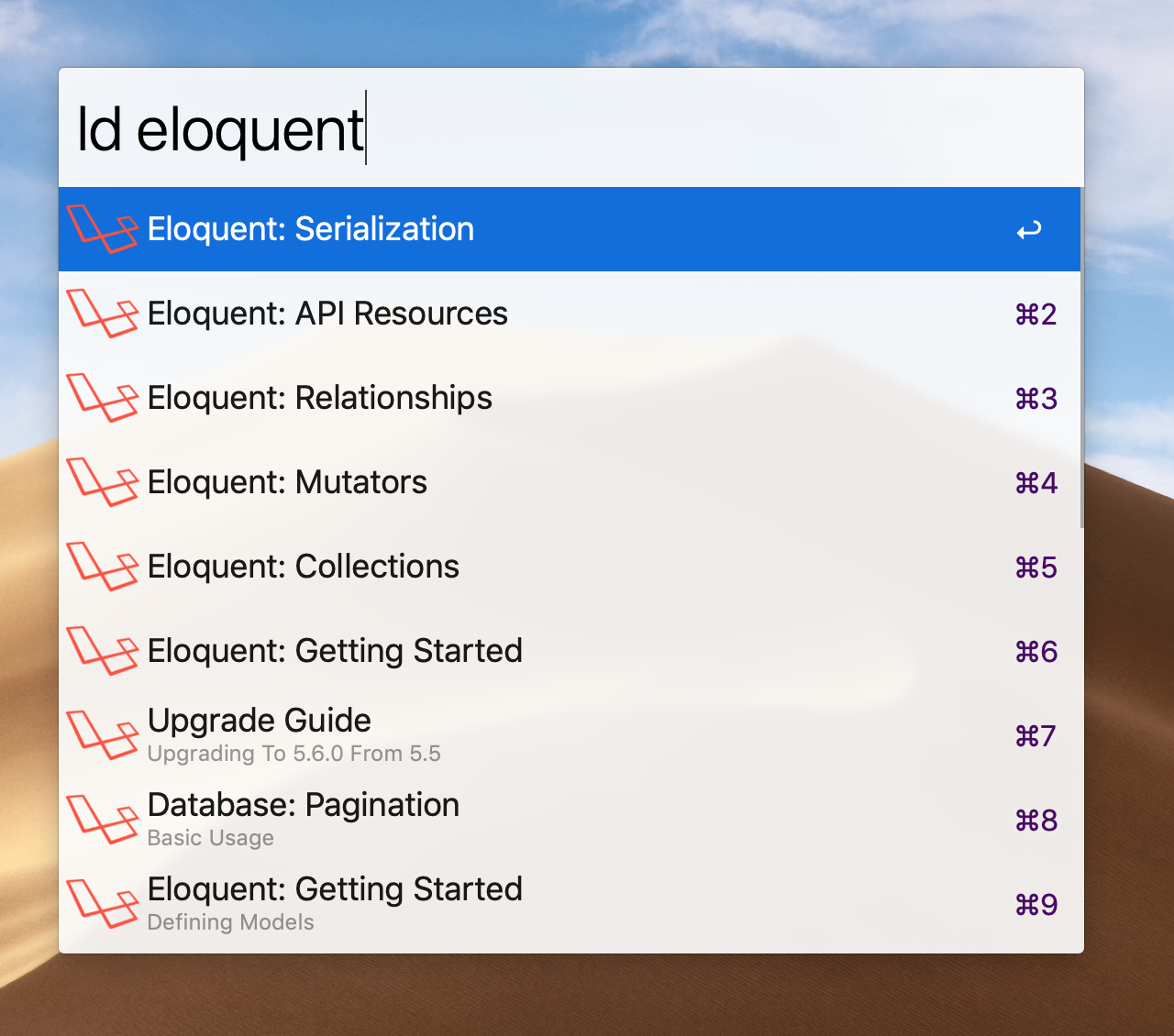
Behind the scenes it uses an Algolia index to retrieve the results. I've been only using it for a day and I can't image how I could have lived without this so long.
https://github.com/tillkruss/alfred-laravel-docs
– Edit
Frederick Vanbrabant recorded a new cool video, this time on EditorConfig.
EditorConfig helps developers define and maintain consistent coding styles between different editors and IDEs. The EditorConfig project consists of a file format for defining coding styles and a collection of text editor plugins that enable editors to read the file format and adhere to defined styles. EditorConfig files are easily readable and they work nicely with version control systems.
– Edit
In a new post on his Medium Blog, Laravel.io maintainer Dries Vints wrote how he managed do drastically improved the build time of the popular forum.
CircleCI 2.0’s builds run with Docker which makes spinning up new instances super fast. If you use pre-built images which are customized to your needs, you don’t even need to do any provisioning during the build which saves you quite a bit time. Pulling various images and orchestrating them in a CircleCI 2.0 config allows for very rapid build times. If you add their new workflows to their mix you could easily enable parallelization and speed things up even more.
https://medium.com/laravelio/how-circleci-improved-our-build-time-8d5c40b8cc60
– Edit
Barry Van Veen shares how you can install a package from a local path into your project. This is extremely handy when developing a package because you can immediately toy with it in a full application.
This article explains how you can require a package from a local path into your project with Composer. This way you can run a local copy of a repository and test any changes you make. Because the local repo will be symlinked changes are shared in real-time, there is no need for intermediate committing and updating.
https://barryvanveen.nl/blog/44-package-development-run-a-package-from-a-local-directory
– Edit
Martin Hujer shares some pretty good tips for working with Composer.
Although most PHP developers know how to use Composer, not all of them are using it efficiently or in a best possible way. So I decided to summarize things which are important for my everyday workflow.
The philosophy of most of the tips is "Play it safe", which means that if there are more ways how to handle something, I would use the approach which is least error-prone.
https://blog.martinhujer.cz/17-tips-for-using-composer-efficiently/