laravel

All my posts about laravel.

Easily convert images with Glide

Glide is an easy to use image manipulation library by Jonathan Reinink. It was bumped to version 1.0.0 a few days ago. Glide can created optimized images on the fly by levering url's such as /img/users/1.jpg?w=300&h=400&fit=crop. Take a look at the example in the Glide documentation to know more.

I think Glide provides a very nice API to create image manipulations. Unfortunately it isn't very easy to use the API to generate an image using code. So I created a little package for that called laravel-glide. All new major versions of Spatie packages will require PHP 7, laravel-glide is no exception to this.

Here's an example of how to create a greyscale version image with a maximum width of 50 pixels.

GlideImage::create($pathToImage)
    ->modify(['filt'=>'greyscale', 'w'=> 50])
    ->save($pathToWhereToSaveTheManipulatedImage);

Take a look at Glide's image API to see which parameters you can pass to the modify-method.

Read more

A PHP 7 / Laravel package to create slugs original

by Freek Van der Herten – 2 minute read

Spatie, the company where I work, recently released a Laravel package called laravel-sluggable. It automatically creates unique slugs when saving a model. To install the package you just need to put the provided Spatie\Sluggable\HasSlug-trait on all models that have slugs. The trait contains an…

Read more

Join 9,500+ smart developers

Get my monthly newsletter with what I learn from running Spatie, building Oh Dear, and maintaining 300+ open source packages. Practical takes on Laravel, PHP, and AI that you can actually use.

No spam. Unsubscribe anytime. You can also follow me on X.

Using collection macros in Laravel

Laravel 5.2 provides some nice additions to the framework. One handy feature that I don't see listed in the release notes is that Collection now is macroable. Using it's macro function you can easily extend Illuminate\Support\Collection with your own custom functions.

Take a look at this piece of code to uppercase every string in a collection.

$uppercaseWords = collect(['code', 'ferengi'])->map(function($word)  {
   return strtoupper($word);
});

That's good code, but image you need to uppercase a lot of collections. Typing the same closure will get very tiresome. Let's improve this with a macro.

use Illuminate\Support\Collection;

Collection::macro('uppercase', function() {

    return collect($this->items)->map(function($word) {
        return strtoupper($word);
    });

});

You could create a service provider to load up these macro's. Now that the macro is defined let's uppercase collections like there's no tomorrow:

$uppercaseWords = collect(['code', 'ferengi'])->uppercase();
$moreUppercaseWords = collect(['love', 'the', 'facade'])->uppercase();
$evenMoreUppercaseWords = collect(['activerecord', 'forever'])->uppercase();

You could be thinking "Why should I use a macro? I can easily to this with a regular function.". Consider this piece of code.

function uppercase($collection) {
...
}

$uppercaseWords = uppercase(collect(['halo','five']));

It works, but you have to encapsulate the collection with your function. The last executed function is put first, which is confusing. With macro's you can still chain functions and greatly improve readability.

//lots of functions
function4(function3(function2(function1(collect(['jack','cheats'])))));

//lots of macros
collect(['i', 'want', 'to', 'live', 'in', 'a', 'desert'])
  ->function1()
  ->function2()
  ->function3()
  ->function4();

Sure, the examples use in this post were a bit contrived, but I hope you see that collection macro's can be very handy.

EDIT: it seems that collection macro's were introduced in Laravel 5.1.25 a month ago.

Read more

Processing big DB tables with Laravel's chunk() method

Povilas Korop shared a neat trick at Laraveldaily.com today.

Let’s imagine the situation: you have a big database table (like 10 000 rows or bigger) and you need to run an update to one column. But you cannot run just SQL query – there is some PHP logic behind it. So foreach loop could potentially take forever or bump into a default 30-second script limit. Luckily, Laravel has a neat solution for it.
http://laraveldaily.com/process-big-db-table-with-chunk-method/

Read more

Exporting json for a mobile app using Laravel

Every year the city of Antwerp (my hometown :-)) organises lots of activities, such as an Ice rink, a Christmas market, a Santa Run and of course fireworks in the month of december. To inform people of which activities are happening where and when my team and I created a mobile app commissioned by the city council. The app is called "Winter in A" and is available on both Android's Play Store and iOS' App Store.

The administrators of the app can enter content in a custom installation of Blender, our Laravel based application. Blender will write of a bunch of json-files that are read by the mobile apps. Here's the file for all the events (english localization): https://api.winterapp.be/en/events.json. We use our homegrown laravel-fractal package to easily transform database records to json. Here's the export handler that's in charge of the exporting of events:

namespace App\Services\Export\ExportHandlers;

use App\Repositories\EventRepository;
use App\Services\Export\ExportHandler;
use App\Services\Export\Transformers\EventTransformer;

class Events implements ExportHandler
{
    /**
     * @var \App\Repositories\EventRepository
     */
    protected $eventRepository;

    public function __construct(EventRepository $eventRepository)
    {
        $this->eventRepository = $eventRepository;
    }

    /**
     * Get the json for the given locale.
     *
     * @param string $locale
     *
     * @return mixed
     */
    public function getJsonForLocale($locale)
    {
        return fractal()
            ->collection($this->eventRepository->getAllOnline())
            ->transformWith(new EventTransformer($locale))
            ->toJson();
    }
}

The EventTransformer itself:

namespace App\Services\Export\Transformers;

use App\Models\Event;
use App\Services\Export\Format;
use App\Services\ValueObjects\Period;
use League\Fractal\TransformerAbstract;
use Spatie\MediaLibrary\Media;

class EventTransformer extends TransformerAbstract
{
    /**
     * @var
     */
    protected $locale;

    public function __construct($locale)
    {
        $this->locale = $locale;
    }

    public function transform(Event $event)
    {
        return [
            'id' => $event->id,
            'name' => $event->translate($this->locale)->name,
            'text' => htmlToMarkdown($event->translate($this->locale)->text),
            ...
            'images' => $event->getMedia('images')->map(function (Media $media) {
                return [
                   'thumb' => $media->getUrl('thumb'),
                   'full' => $media->getUrl('full')
                ];
            }),
        ];
    }
}

To handle peaks in usage of the app we use CloudFlare. In this article they explain what they do. Cloudflare has this awesome feature called "Always online", to make sure the API is online even if our server is not.

The first events of Winter in Antwerp are starting tomorrow. The last ones are scheduled in the first days of 2016. I'll share some more tidbits of the code then.

Read more

Enabling autocompletion for dynamic return types in PhpStorm

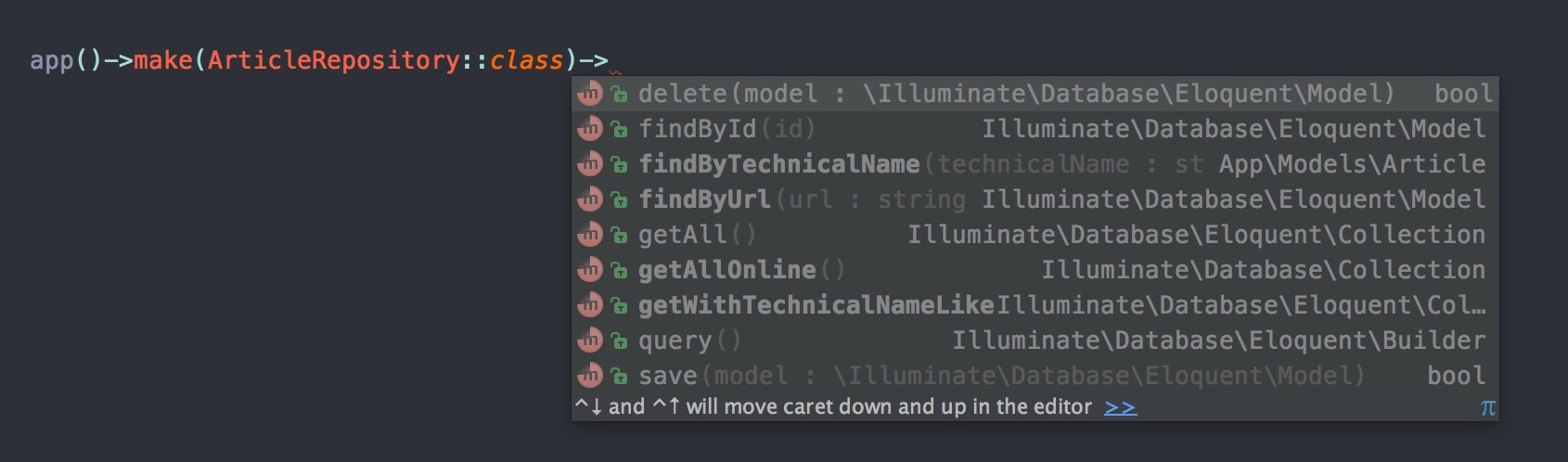
If you're using PhpStorm you probably make heavy use of it's autocomplete features. The IDE can, for most classes, suggests all accessible functions. Unfortunately, when a function has a dynamic return type PHPStorm will leave you out in the cold. So when resolving something out of Laravel's IoC-container PhpStorm cannot help you. Here's an example with one of the repositories of Blender:

Screen Shot 2015-12-04 at 20.42.42

PhpStorm can't suggest functions because it doesn't know which class the make-function will return. Let's fix that.

The DynamicReturnType plugin provides a way to dynamically specify the return type of a function. You can install it like every other PHPStorm plugin. Next you'll have to create a file called dynamicReturnTypeMeta.json in the root of your project with this contents:

{
    "methodCalls": [
        {
            "class": "\\Illuminate\\Contracts\\Foundation\\Application",
            "method": "make",
            "position": 0
        }
    ]
}
```

This configuration will tell PHPStorm that the return type of the make-function of Illuminate\Contracts\Foundation\Application will return an instance of class specified in the first argument.

With this file in place PHPStorm can perform autocompleting:

Screen Shot 2015-12-04 at 20.34.59

To learn all other possibilities the plugin offers, read it's documentation on GitHub.

Update: As Nicolas Widart mentions in the comments below there's another (and maybe easier way) to get autocompletion when resolving stuff from Laravel's IoC-container. The ide-helper package can generate a meta file that, when indexed, will make PhpStorm understand which object gets returned.

Read more

A package to check all links in a Laravel app original

by Freek Van der Herten – 1 minute read

A few weeks ago I made a cli tool to check the status code of all links on a site. It made use of a home grown crawler. Today the Laravel integration gets released. The new package called laravel-link-checker can log all broken links. By default, a link is considered broken if the status code of…

Read more

This blog is one year old original

by Freek Van der Herten – 2 minute read

Exactly one year ago the very first post on murze.be was published. This blog was mainly started as a way to bookmark interesting links. Along the way I shared programming tips, talked a bit about learning and gave some background on the Spatie packages. It's been a fun ride and looking at the…

Read more

Zero downtime deployments with Envoy original

by Freek Van der Herten – 4 minute read

Envoy is Laravel's official task runner. Using a Blade style syntax tasks can be defined that can be run both locally and remotely. At Spatie, we've been using Envoy for quite some time to deploy code on production servers. Summarized our trusty Envoy script did the following things: bringing the…

Read more

Validate (almost) anything in Laravel original

by Freek Van der Herten – 1 minute read

Laravel ships with some good validation capabilities. Form request validation is a nice way to make sure http requests pass valid data. To validate stuff that enters the application in some other way validators can be created manually. Unfortunately this is kinda verbose: $validator =…

Read more

Building a crawler in PHP original

by Freek Van der Herten – 4 minute read

When Spatie unleashes a new site on the web we want to make sure that all, both internal and external, links on it work. To facilitate that process we released a tool to check the statuscode of every link on a given website. It can easily be installed via composer: composer global require…

Read more

On open sourcing Blender original

by Freek Van der Herten – 3 minute read

At Spatie we use a homegrown Laravel template called Blender. It's being used on nearly all our projects. When starting with a greenfield project we take a copy of Blender and make project specific changes in that copy. We built it because we want maximum flexibility and don't want to be hampered by…

Read more

A pjax middleware for Laravel 5 original

by Freek Van der Herten – 1 minute read

A few days ago Jeffrey Way published an interesting lesson on how to integrate pjax with Laravel. Pjax is jquery plugin that leverages ajax to speed up the loading time of webpages. It works by only fetching specific html fragments from the server, and client-side updating only certain parts of the…

Read more

Custom conditionals with Laravel's Blade Directives

Matt Stauffer explains when and how you can leverage custom blade directives.

One of the greatest aspects of Laravel Blade is that it's incredibly easy to handle view partials and control logic. I find myself frequently extracting the contents of a loop out to a Blade partial and then passing just a bit of data into the partial.

But sometimes the repetitive code isn't the view itself, but the conditional logic I'm running.

https://mattstauffer.co/blog/custom-conditionals-with-laravels-blade-directives

Read more

A Fractal service provider for Laravel original

by Freek Van der Herten – 1 minute read

Today I released a new package called laravel-fractal. It provides a Fractal service provider for Laravel. If you don't know what Fractal does, take a peek at their intro. Shortly said, Fractal is very useful to transform data before using it in an API. Using Fractal data can be transformed like…

Read more

Redirect every request in a Laravel app original

by Freek Van der Herten – 1 minute read

I recently had to redirect every single request in a Laravel app. You might think that would be as easy as this: Route::get('/', function() { return redirect('https://targetdomain.com'); }); But that'll only redirect the "/" page. All other requests will return a 404.…

Read more

A middleware to check abilities on the route level original

by Freek Van der Herten – 1 minute read

Laravel's native authorization functionality allows you to define abilities a user can have. There are multiple ways to check if a user has a certain ability: via the facade, via the user model, within blade templates and within form requests. What Laravel doesn't provide out of the box is a…

Read more