Posts tagged with developer

Stack Overflow's Developer Survey results

Every year Stack Overflow runs as survey where they asks their users about their favourite tools, languages, etc... A little while ago they published the results of the 2017 edition.

We learn something new every time we run our survey. This year is no exception:

- A common misconception about developers is that they've all been programming since childhood. In fact, we see a wide range of experience levels. Among professional developers, 11.3% got their first coding jobs within a year of first learning how to program. A further 36.9% learned to program between one and four years before beginning their careers as developers. - Only 13.1% of developers are actively looking for a job. But 75.2% of developers are interested in hearing about new job opportunities. - When we asked respondents what they valued most when considering a new job, 53.3% said remote options were a top priority. A majority of developers, 63.9%, reported working remotely at least one day a month, and 11.1% say they’re full-time remote or almost all the time. - A majority of developers said they were underpaid. Developers who work in government and non-profits feel the most underpaid, while those who work in finance feel the most overpaid.

https://stackoverflow.com/insights/survey/2017/

Read more

Some people to follow on Twitter

by Freek Van der Herten – 2 minute read

There are a lot of developers active on Twitter. Most of them tweet out interesting links, their opinions or stuff they're working on. I think Twitter is an excellent tool to stay in touch with what's going on in the Laravel and PHP community. If you're looking for some people to follow here are…

Read more

Join thousands of developers

Every two weeks, I share practical tips, tutorials, and behind-the-scenes insights from maintaining 300+ open source packages.

No spam. Unsubscribe anytime. You can also follow me on X.

Top 5 programming fonts

Eric L. Barnes of Laravel-news and dotdev fame, did a little research on the most used fonts for programming.

Everyone has their ideal development setup, and many have spent countless hours customizing it to perfectly suit their needs. Outside of a color scheme, the next typical change is the font in use and every year new fonts are introduced giving us more to choose from than ever before.

To find out what everyone is using, I asked on Twitter and Facebook and had a ton of responses. Based on the answers here is a list of the top 5 programming fonts in use today

https://laravel-news.com/2016/10/top-5-programming-fonts/

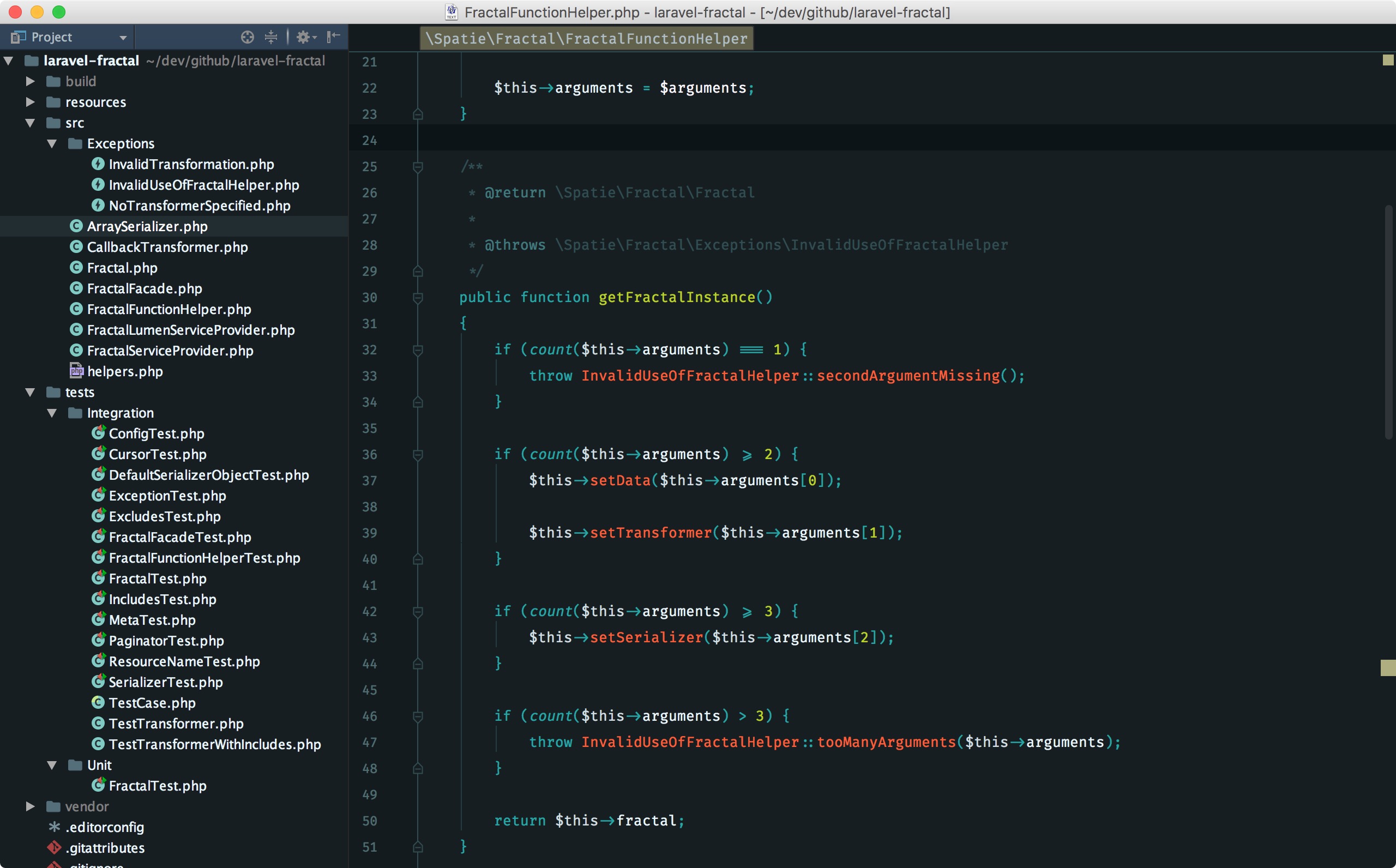
I'm a big fan of Fira Code myself. It has some nice ligatures and it just looks very good. Here it is in action in my IDE:

screen-shot-2016-10-21-at-23-56-34

Read more

How I open sourced my way to my dream

Laravel employee #1, Mohammed Said, recently gave an interview at codeforaliving.io on his career and how he started with open source. Terrific story. A lot of what he says resonates with how I feel about working on open source.

Said believes many developers, in the Middle East and elsewhere, are interested in the open source community, but not sure how to get started: “They think they have to wait until they have something perfect.” That’s simply not the case, Said maintains. He encourages developers to dig deep into their favorite projects, especially into software they work with on a daily basis, and look for places they can offer “enhancements” to existing code.

Open source, he believes, is the best experience a developer can show in an interview. “Tech interviewers want one thing,” he says: “Show me your code.” You can share code you’ve written for your day job, but it’s probably impersonal or boring or even proprietary and closed source, so you can’t share it at all. Some code at work is done as part of a team and you can’t pick out what you did and what Jane down the hall did. Open source, on the other hand, is all you. It’s your passion, it’s publicly accessible, and it has your name on it.

http://www.codeforaliving.io/how-i-open-sourced-my-way-to-my-dream-job-mohamed-said

Read more

Computer Vision Syndrome

Eric L. Barnes explains what Computer Vision Syndrome is, and what you can do to avoid it.

In no point in human history have people been staring at bright screens just a few feet from their face like they are today. Computer vision syndrome or CVS (not to be confused with Concurrent Versions System) is one side effect to this, and it’s affecting millions of people.

The National Institute of Occupational Safety and Health reports computer vision syndrome affects about 90% of the people who spend three hours or more a day at a computer, which means almost everyone in our industry is susceptible.

https://laravel-news.com/2016/09/computer-vision-syndrome/

Read more

Finding time to become a better developer

Bill Sourour has some good tips on how to manage your time.

There’s no time for anything. At least that’s how it feels doesn’t it? No time to learn all the things you think you need to learn to stay ahead of the curve. No time to go back and refactor that ugly piece of code. It works (sort of) and there’s a deadline approaching. No time to write unit tests for everything. No time to write documentation or comments for the next guy who gets stuck maintaining what you wrote. No time to think. No time to breathe. No time!

Well… if you take the time to read this article, I promise you’ll find yourself with more time for what’s important.

https://medium.freecodecamp.com/finding-time-to-become-a-better-developer-eebc154881b2

Read more

The syntax of tech communities

Davey Shafik dissects the values of several tech communities in a new post on his blog.

Just like the programming languages that are the centers of our communities, each community has its own set of rules and idioms — they have a real life syntax.

In my (almost) three years of being in a developer relations type role I have attended events in several communities and have observed how they differ from my primary community (PHP). As I’ve tried to understand those differences and the reasons behind them, I have had many discussions with members of many more communities also.

After attending my first PyCon (US) I was struck by just how welcoming and diverse the community is and had many conversations trying to understand why this is. This is not what this post is about. This post is about conferences specifically, and how communities place different priorities on different things when it comes to how they run, organize, speak at, and attend events.

https://daveyshafik.com/archives/69985-the-syntax-of-tech-communities.html

Read more

What does it take to be a great developer?

Eric L. Barnes asked this question to people with several backgrounds.

I love questions that can’t be answered with a simple yes or no. One question that I have been thinking about recently is, just what does it take to be a great developer?

I came up with tons of answers but felt like mine are all through my own lens, so I decided to reach out to a few people from different walks of life and just ask them. What follows is the answer by each person and their profession so you can compare and contrast.

https://dotdev.co/what-does-it-take-to-be-a-great-developer-a2eddb0c47e6#.sf8kwd8tv

Read more

Being A Developer After 40

Adrian Kosmaczewski shares lessons learned on what truely are the important things in your career as a developer. Even if you're not even close to approaching 40 years of life on the planet you should read this.

I have often pondered about leaving the profession altogether. But somehow, code always calls me back after a while. I like to write apps, systems, software. To avoid burning out, I have had to develop strategies.

In this talk I will give you my secrets, so that you too can reach the glorious age of 40 as an experienced developer, willing to continue in this profession.

...

As long as your heart tells you to keep on coding and building new things, you will be young, forever.
https://medium.freecodecamp.com/being-a-developer-after-40-3c5dd112210c#.11l62gnmg

Read more

Heroes of PHP

Following the conclusion of the 24 Days in December series on PHP, I originally posted my own 24 “Heroes of PHP”™ on Twitter.

I’m reproducing that list here, together with some additional explanation of why these individuals mean so much to me.

...

These are just some of my personal heroes, inspirations and role models, I’m sure that you have your own “Heroes of PHP”; but they all deserve thanks for the time and effort that they devote to improving our lives as PHP developers.

http://markbakeruk.net/2016/01/26/heroes-of-php-1/

Read more

How to become a great engineer

Philip Walton, an engineer at Google, wrote a wonderful article that every developer should read. He talks about front-end engineers, but most tips are applicable to back-end engineers as well. A few quotes:

Taking the time to figure out why your hack works may seem costly now, but I promise it’ll save you time in the future. Having a fuller understanding of the systems you’re working within will mean less guess-and-check work going forward.
Solving problems on your own is a great way to learn, but if that’s all you ever do, you’ll plateau pretty quickly. Reading other people’s code opens your mind to new ways of doing things.
In my experience, writing, giving talks, and creating demos has been one of the best ways to force myself to dive in and fully understand something, inside and out. Even if no one ever reads what you write, the process of doing it is more than worth it.
Be sure to read the full article here: http://philipwalton.com/articles/how-to-become-a-great-front-end-engineer/

Read more

Why developers hate being interrupted

Developers can appear very unproductive at times, sitting staring at the screen with our headphones on and very little in the way of keyboard clackety-tap. This however is when we are doing our thinking, when we are building up, adding to and rearranging the mental model of how our code will work. This is the biggest and hardest part of development.

Imagine how it feels to have that interrupted at random by a telephone call or somebody walking over to talk to you. It’s horrible.

http://thetomorrowlab.com/2015/01/why-developers-hate-being-interrupted/

Read more

I crashed the web servers of a $100M+ multi-national corporation

A great story by Derick Bailey of Watchmecode.net

The important lesson, ..., was that I owned up to the mistake, dug in and fixed it, and learned how to avoid the problem in the future. I was, in his mind, a better developer at the end of that day. I had survived a catastrophic crash of my own making and I had fixed the problem, learning some very valuable lessons in business down time and in code that day.
http://derickbailey.com/email_archive/i-crashed-the-web-servers-of-a-100m-multi-national-corporation/

Read more

The taxonomy of terrible programmers

I present you with the taxonomy of terrible software developers, the ecosystem of software critters and creatures who add a whole new meaning to the concept of “defensive programming.”

At one point or another, every programmer exists as at least one of these archetypes – the good ones see these bad habits in themselves and work to fix them over time. The bad ones… simply are.

http://www.aaronstannard.com/the-taxonomy-of-terrible-programmers/

Read more