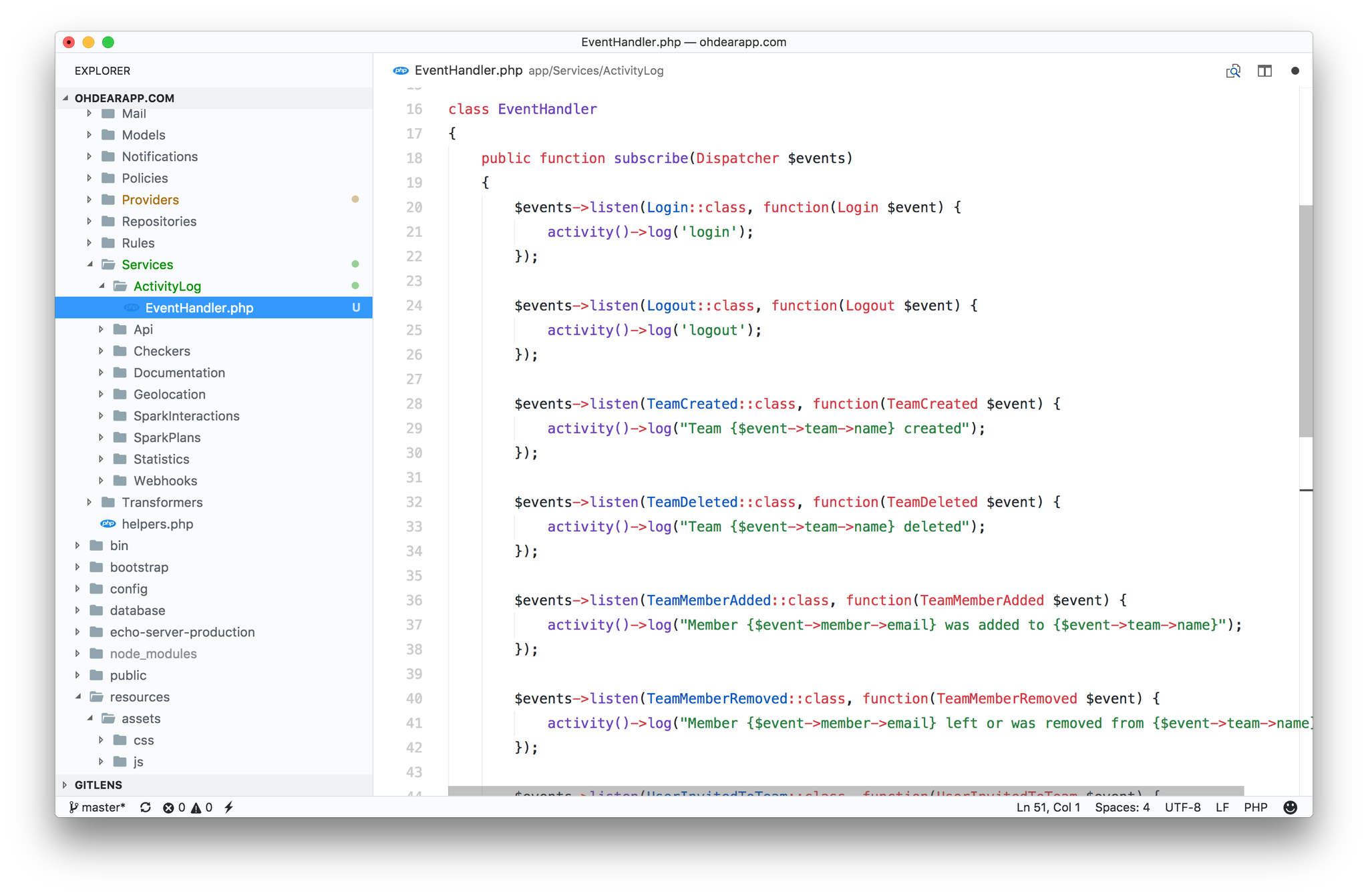
Using global mixins in Vue.js original

by Freek Van der Herten – 2 minute read

Recently I needed to add some global functionality to nearly all Vue components in an app. My colleague Seb told me a good way to achieve this: global mixins. In this post I'd like share that knowledge. In Vue a mixin is some functionality bundled in a file that can be added to one or more Vue…

Read more

Join 9,500+ smart developers

Get my monthly newsletter with what I learn from running Spatie, building Oh Dear, and maintaining 300+ open source packages. Practical takes on Laravel, PHP, and AI that you can actually use.

No spam. Unsubscribe anytime. You can also follow me on X.

CSS Utility Classes and "Separation of Concerns"

In my day to day work I don't write any css at all, but I still very much enjoyed this blogpost by Adam Wathan where he shares some interesting things about how css should be structured and he makes the case for using utility classes to make visual tweaks.

When you think about the relationship between HTML and CSS in terms of "separation of concerns", it's very black and white.

You either have separation of concerns (good!), or you don't (bad!). This is not the right way to think about HTML and CSS. Instead, think about dependency direction.

...

One of the biggest benefits of using small, composable utilities is that every developer on your team is always choosing values from a fixed set of options.

https://adamwathan.me/css-utility-classes-and-separation-of-concerns/

Read more

The disadvantages of single page applications

Adam Silver lists a bunch of problems you need to solve if you opt to build a single page application.

Ironically, SPAs are harder to design and harder to build. And yet, they typically produce slow, disagreeable experiences for users. ... Javascript is never going to beat the browser at what it does best—browsing. We can still give users rich and enhanced experiences without cramming an entire site into one document.

We should let the browser manage the browsing experience, and spend our time solving real user problems.

https://adamsilver.io/articles/the-disadvantages-of-single-page-applications/

Read more

Precision Through Imprecision: Improving Time Objects

Ross Tuck is probably one of my favourite bloggers. He doesn't publish something often (his previous post is from 2015), but when he does it's very much worth your time.

The important takeaway here isn’t “value objects, yay, inline juggling, boo!” It’s that we were able to remove several classes of errors by reducing the precision of the DateTime we were handling. If we hadn’t done that, the value object would still be handling all of these edges cases and probably failing at some of them too.

Reducing the quality of data to get a correct answer might seem counter-intuitive but it’s actually a more realistic view of the system we’re trying to model. Our computers might run in picoseconds but our business (probably) doesn’t. Plus, the computer is probably lying anyways.

http://rosstuck.com/precision-through-imprecision-improving-time-objects

Read more

Calculating distance using MySQL

Logan Henson, a developer at Tighten, wrote a new post on the company blog about MySQL's cool ST_Distance_Sphere function.

On a client project recently, we had to make it easy to filter database query results based on the distance between a user and an entity in our database. It's easy to get overwhelmed in that context, worrying about the crazy amount of PHP calculations you're going to have to run. ... If you need to calculate this, you can actually get surprisingly far by just using MySQL!

https://tighten.co/blog/a-mysql-distance-function-you-should-know-about

Read more

Language features and code properties

Josh Justice gives some solid advice on how to pick the right language for your next projects.

So to ask the question “should I use an OO or FP language (or style)” is to skip several steps. I think a better series of questions are: First, what properties would be beneficial for your application to have: concurrency? Immutability? Encapsulation? There are a lot of things you won’t know about your application at first, but you can at least know if it will be a backend app, JavaScript browser app, or native mobile app; if it will be CPU-bound or IO-bound; and if it will process data inputted by humans or automatically generated by machines. All of those factors can influence which properties you need.

Once that’s decided, the next question is, in a given language, are those properties guaranteed, easy, difficult, or not realistically achievable?

http://codingitwrong.com/2017/07/27/language-features-and-code-properties.html

Read more

Why using Yoda conditions you should probably not be

Grégoire Paris wrote down his opinion on why he dislikes Yoda conditions.

So how do Yoda conditions work? Well it is basically a knee-jerk reaction you have to develop: whenever you write a condition, put the operand that cannot be assigned on the left. This should give you an error message if you make an assignment when you actually meant to make a comparison.

https://dev.to/greg0ire/why-using-yoda-conditions-you-should-probably-not

Personally, I'm not a big fan of Yoda conditions either. My feeling is the the cost of decreased readability is just too high for the small value that Yoda conditions bring to the table.

Read more

Cruddy by design

At this year's Laracon US Adam Wathan gave a talk titled "Cruddy By Design" on how to structure your controllers better. After the conference he published a new GitHub repo that contains the demo app he refactored on stage. The 4 main tips to improve your code come as PRs on the repo with a full description on why the change is valuable. Very cool stuff.

Using this convention as a "rule" is a good way to force yourself to keep your controllers from becoming bloated, and can often lead to learning interesting new things about your domain.

For the presentation, I put together a demo app called "CastHacker" that showcases podcasts about software development. It's not a "real" app by any means (lots of imaginary features, no tests, etc.); it's just enough code to demonstrate the concepts from the presentation. Feel free to clone it and play with it locally if you like though.

I've written up each refactoring I shared in the presentation as a detailed pull request.

https://github.com/adamwathan/laracon2017

Read more

How to write JavaScript-style test watchers in PHP

Christoper Pitt published another excellent piece over at Sitepoint. This time he describes how he built a watcher to automatically recompile his preprocessed code and rerun the tests.

In order to reduce the burden of invoking the transformation scripts, boilerplate projects have started to include scripts to automatically watch for file changes; and thereafter invoke these scripts.

These projects I’ve worked on have used a similar approach to re-run unit tests. When I change the JavaScript files, these files are transformed and the unit tests are re-run. This way, I can immediately see if I’ve broken anything.

https://www.sitepoint.com/write-javascript-style-test-watchers-php/

Read more

Diving into Laravel Horizon

Laravel Horizon is a kickass dashboard for viewing queued jobs. Co-creator Mohammed Said published two posts about the inner working of the tool. The first one on the Diving Laravel site highlights the overall configuration and how the master supervisor works.

Laravel Horizon is a queue manager that gives you full control over your queues, it provides means to configure how your jobs are processed, generate analytics, and perform different queue-related tasks from within a nice dashboard.

In this dive we're going to learn how Horizon boots up and handles processing jobs using different workers as well as how it collects useful metrics for you to have the full picture of how your application dispatches and runs jobs.

https://divinglaravel.com/horizon/before-the-dive

The second one, published on his own blog, shows how queued jobs can get tagged.

Laravel Horizon is shipped with many amazing features that help you understand what goes on with your queue workers, my personal favorite feature is the ability to tag jobs for further investigation.

https://themsaid.com/tagging-jobs-in-laravel-horizon-20170731

Read more

A recap of Laracon US 2017

Laracon US 2017 was an amazing conference. Sid published this excellent recap that contains many links to slides and related content.

I attended my first Laracon in person and I have to say I really enjoyed the experience — maybe more than I expected to. It was well organised and the talks were diverse, informative and actionable. Day 1 was all technical and mostly revolved around Laravel. Day 2 had a different mix of talks and the non-technical ones were thought-provoking and entertaining.

https://medium.com/koomai/laracon-2017-a-recap-and-links-galore-c233be2de670

Read more

Webpack Academy

Sean Larkin, core team member of Webpack, will be leaving his current job at Mutual of Omaha for a new position at Microsoft. Because on his team he was the one most familiar with the webpack setup of the project, he looked for a way to transfer his knowledge. He landed on creating a video course on webpack that's free for everyone.

I decided to create Webpack Academy, a training and educational platform for those wanting to learn more about webpack. This was a perfect way to not only allow me to give back to my team — by giving them free access to all of the content — but to also benefit the community by sharing it with everyone.

https://webpack.academy/

Read more

How to analyze tweet sentiments with PHP Machine Learning

In a post on Sitepoint Allan MacGregor gives a good practical example on how to work with PHP-ML, a machine learning library for PHP.

As of late, it seems everyone and their proverbial grandma is talking about Machine Learning. Your social media feeds are inundated with posts about ML, Python, TensorFlow, Spark, Scala, Go and so on; and if you are anything like me, you might be wondering, what about PHP?

Yes, what about Machine Learning and PHP? Fortunately, someone was crazy enough not only to ask that question, but to also develop a generic machine learning library that we can use in our next project. In this post we are going take a look at PHP-ML – a machine learning library for PHP – and we’ll write a sentiment analysis class that we can later reuse for our own chat or tweet bot.

https://www.sitepoint.com/how-to-analyze-tweet-sentiments-with-php-machine-learning/

Read more

Achieving Geo-search with Laravel Scout and Algolia

On Scotch.io a new post by Julien Bourdeau was published that shows how you can easily import and search geographic data with Laravel Scout and Algolia.

Laravel Scout makes it very easy to setup an external search engine to create consumer-grade search quickly. The package comes with Algolia as a default search engine. I'd like to demonstrate how to make use of the geo-location search feature with Scout.

In this tutorial, you'll learn how to prepare your data for Algolia and Laravel Scout to retrieve items based on location.

https://scotch.io/tutorials/achieving-geo-search-with-laravel-scout-and-algolia

Read more

Optimize images in Laravel apps original

by Freek Van der Herten – 3 minute read

A while ago we released image-optimizer. In short this package can make all kinds of images smaller by stripping out metadata and applying a little bit of compression. Read this blogpost to learn more about it. Although it's pretty easy to work with the package, we felt that we could deliver a more…

Read more