Improving the output of PHPUnit
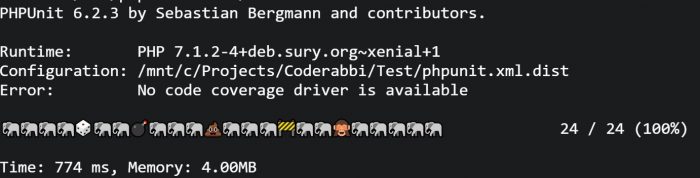
Let's have a little fun! Yitzchok Willroth, better know as Coderabbi, created a new package that can improve the output of PHPUnit.
Here's what the output of a testrun looks like with his package installed.
Posts tagged with tool
Let's have a little fun! Yitzchok Willroth, better know as Coderabbi, created a new package that can improve the output of PHPUnit.
Here's what the output of a testrun looks like with his package installed.
Even though I'don't like Facebook as a user, their amazing contributions to open source are something to be very grateful for. Last week they presented their new work in progress: Prepack.
Prepack is a tool that optimizes JavaScript source code: Computations that can be done at compile-time instead of run-time get eliminated. Prepack replaces the global code of a JavaScript bundle with equivalent code that is a simple sequence of assignments. This gets rid of most intermediate computations and object allocations.
It's still in development, so best not use it in production environments yet.
Join 9,500+ smart developers
Get my monthly newsletter with what I learn from running Spatie, building Oh Dear, and maintaining 300+ open source packages. Practical takes on Laravel, PHP, and AI that you can actually use.
No spam. Unsubscribe anytime. You can also follow me on X.
"Always fresh, useful tips and articles. Carefully selected community content. My favorite newsletter, which I look forward to every time."
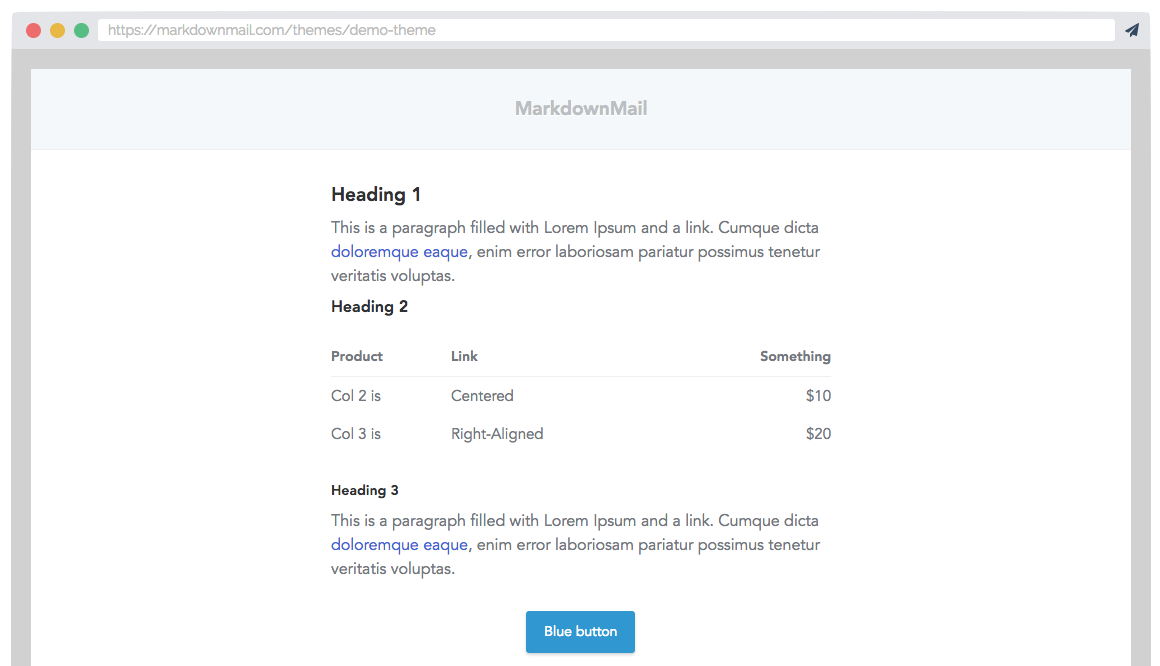
Bobby Bouwmann, a very helpful guy, created a new free service that can generate email markdown themes for use in a Laravel application.
Colin Viebrock, author of the well know laravel-sluggable package, created a new Sequel Pro bundle that can genenerate Laravel migration files.
Connect to a database, and select a table in the left-hand column. From the application menu, choose Bundles › Export › Export to Laravel Migration. The resulting Laravel migration file will be saved to your desktop. You can then move this file into your Laravel project (usually /database/migrations) and then run artisan migrate.
Because Laravel comes with excellent scheduling functions out of the box, artisans don't need to edit the crontab often. If you need to do some scheduling manually, here's a little site that can help you write a cron scheduling expression.
Every single day I use Sequel Pro to manage MySQL databases for all projects I'm working on. Sequel Pro gets used in both development and production environments. Because the databases mostly have the same name and tables in all environments it's very easy to mix them up. You have to be really…
The Query Tracer package can help you find out where a specific database query is being called. It works with both Clockwork and the Laravel Debugbar. Here's a screenshot taken from the readme:

https://github.com/fitztrev/query-tracer
EDIT: turns out that Laravel Debugbar can do this out of the box:
In the JavaScript world converting modern code to an older syntax is quite common. In the PHP world you don't see that happen often. Symfony provides a few polyfills, but a full fledged conversion isn't available. At the meetup of our local PHP user group Jens Segers, Hannes Van de Vreken and I were toying around with the idea of converting PHP 7 code to equivalent PHP 5 code automatically.
Today our little hobby project called 7to5 was tagged 1.0.0. You can view the repo on GitHub.
Because there are a lot of small things that cannot be detected and/or converted properly it is not guaranteed that the converted code will work. It's highly recommended to run your automated tests against the converted code to determine if it works.
composer install global spatie/7to5
Once that's done you can use php7to5 to convert a whole directory in one go:
php7to5 convert {$directoryWithPHP7Code} {$destinationWithPHP5Code}
Image how you would convert this:
class Test
{
    public function test()
    {
        $class = new class() {
            public function method(string $parameter = '') : string {
                return $parameter ?? 'no parameter set';
            }
        };

        $class->method();

        $anotherClass = new class() {
            public function anotherMethod(int $integer) : int {
                return $integer > 3;
            }
        };
    }

}
to this:
class AnonymousClass0
{
    public function method($parameter = '')
    {
        return isset($parameter) ? $parameter : 'no parameter set';
    }
}

class AnonymousClass1
{
    public function anotherMethod($integer)
    {
        return $integer < 3 ? -1 : ($integer == 3 ? 0 : 1);
    }
}

class Test
{
    public function test()
    {
        $class = new AnonymousClass0();
        $class->method();
        $anotherClass = new AnonymousClass1();
    }
}
After the meetup of our usergroup the idea lay dormant for a while, but at this year's PHPUKConference Hannes decided to just do it™. I was immediately pulled in. We ran over a few options. It quickly became apparent that using regex was out of the question. Using a state machine would become very unwieldy fast too. We settled on using the PHP parser tool created by Nikita Popov. This tool can convert PHP code to an abstract syntax tree. It's very similar to a domtree for html code. Here's an example (taken from the php parser docs). This code:
echo 'Hi', 'World';
hello\world('foo', 'bar' . 'baz');
will get converted to this tree:
[
    0: Stmt_Echo(
        exprs: [
            0: Scalar_String(
                value: Hi
            )
            1: Scalar_String(
                value: World
            )
        ]
    )
    1: Expr_FuncCall(
        name: Name(
            parts: [
                0: hello
                1: world
            ]
        )
        args: [
            0: Arg(
                value: Scalar_String(
                    value: foo
                )
                byRef: false
            )
            1: Arg(
                value: Expr_Concat(
                    left: Scalar_String(
                        value: bar
                    )
                    right: Scalar_String(
                        value: baz
                    )
                )
                byRef: false
            )
        ]
    )
]
Here's the code to create the abstract syntax tree.
//create a parser
$parser = (new PhpParser\ParserFactory())->create(PhpParser\ParserFactory::PREFER_PHP7);

//feed it PHP 7 code
$php7code = file_get_contents($pathToPhp7File);

//this variable now contains the entire syntax tree
$syntaxTree = $parser->parse($php7code);
Now that we have created the abstract syntax tree, let's manipulate it. The tree can be traversed by a Traverser. The manipulation can be done by one or more Visitors objects. Let's view some code that traverses the tree and converts it back to regular PHP code.
$traverser = new PhpParser\NodeTraverser();

$traverser->addVisitor(new NullCoalesceReplacer());

$manipulatedTree = $traverser->traverse($syntaxTree);

//convert the tree back to regular code
$code = (new \PhpParser\PrettyPrinter\Standard())->prettyPrintFile($manipulatedTree);

file_put_contents($pathToFileWithManipulatedPhpCode, $code);
The real magic happens in the NullCoalesceReplacer class. It will convert all usages of the null coalesce operator, which is exclusive to PHP 7, to equivalent PHP 5 code. This class is not a part of Nikita's package. Hannes and I created it together with all other visitors.
Before taking a look at the code of that class, we'll first examine how we would manually replace a null coalesce operator.
//PHP 7 code
$result = $input ?? 'fixed-value';

//equivalent PHP 5 code
$result = isset($input) ? $input : 'fixed-value';
Let's describe the needed conversion in plain English. We'll need to create a ternary statement. The left hand side of the '??' needs to put in an isset statement. The true branch of the ternary statement needs to use the left hand side of the '??'-operator, the false branch needs the right hand side.
Here's the code of the NullCoalesceReplacer-visitor.
namespace Spatie\Php7to5\NodeVisitors;

use PhpParser\Node;
use PhpParser\Node\Expr\BinaryOp\Coalesce;
use PhpParser\NodeVisitorAbstract;

class NullCoalesceReplacer extends NodeVisitorAbstract
{
    public function leaveNode(Node $node)
    {
        //don't do at thing if the given node is not a Coalesce operator we
        if (!$node instanceof Coalesce) {
            return;
        }

        //create an isset functional call with the left side of '??' as the first parameter
        $issetCall = new Node\Expr\FuncCall(new Node\Name('isset'), [$node->left]);

        //replace the entire node by a ternary statement
        return new Node\Expr\Ternary($issetCall, $node->left, $node->right);
    }
}
Let's review another visitor. This one will remove all scalar type hints:
namespace Spatie\Php7to5\NodeVisitors;

use PhpParser\Node;
use PhpParser\Node\Param;
use PhpParser\NodeVisitorAbstract;

class ScalarTypeHintsRemover extends NodeVisitorAbstract
{
    public function leaveNode(Node $node)
    {
        if (!$node instanceof Param) {
            return;
        }

        if ($this->isScalar($node->type)) {
            $node->type = null;
        }
    }

    /**
     * @param string|null $type
     *
     * @return bool
     */
    protected function isScalar($type)
    {
        return in_array($type, ['int', 'integer', 'float', 'string', 'bool', 'boolean']);
    }
}
Using an abstract syntax tree sure makes manipulating code fairly readable. There are quite a number of other visitors. You can take a look at them on GitHub.
Meanwhile a more featured rich project that converts PHP 7 code has popped up (so if you do want to convert some PHP 7 code take a look at that one too).
At work I’m working on a project in which we need to track the share count of an URL. Below are my quick notes.https://www.bram.us/2016/01/11/getting-the-share-count-of-a-url/
A few weeks ago I made a cli tool to check the status code of all links on a site. It made use of a home grown crawler. Today the Laravel integration gets released. The new package called laravel-link-checker can log all broken links. By default, a link is considered broken if the status code of…
Climb checks your composer files to see which packages are outdated, regardless of your version constraints. Without Climb, there's no way of knowing if a package has a new major release unless you use a notification system like Gemnasium. Climb is one of those tools you just need to get on your tool belt.http://jenssegers.com/78/check-outdated-composer-packages-with-climb
When Spatie unleashes a new site on the web we want to make sure that all, both internal and external, links on it work. To facilitate that process we released a tool to check the statuscode of every link on a given website. It can easily be installed via composer: composer global require…
Maxime Fabre has created the best RFC tracker out there. I'll probably use his tracker more than then the official pages.
The PHP internals need to be improved, it's not new, I know it, you know it. Between the wiki, the dozens of mailing lists, the Github repository and so on, information is spread out across the web; difficult to access, to comprehend, and to participate in. If you're not familiar with it, it's an unwelcoming world to whomever might want to know more about advances in the PHP language.http://why-cant-we-have-nice-things.mwl.be/This tool aims to simplify this by unifying sources of information under one roof, and answer all the questions people might have about the PHP internals. Who voted on what? Who even are the people voting? What did they also vote on? What comments were made on a particular RFC? And so on.
httpie is a command-line http client, much like cURL or wget. Written entirely in Python (using requests for the backend and pygments for syntax highlighting), it’s well portable to many platforms, including the big three Windows, Linux and OSX.http://radek.io/2015/10/20/httpie/
When installing an SSL certificate on your server you should install all intermediate certificates as well. If you fail to do so, some browsers will reported “untrusted” warnings for your site like this one.

Searching and downloading those intermediate certificates can be a hassle.
Today my colleagues at Spatie and I launched certificatechain.io. This online tool helps you download all intermediate certificates. Just paste or upload your certificate and you'll get a file containing the entire trust chain that you can install on your server.
The site is built with Laravel 5 and uses the SSL certificate chain resolver we made last month.
This tool allows you to list all your DO-droplets, SSH into them, take a snapsnots, resize them, and more from the command line.
All operating systems contain a set of default trusted root certificates. But CAs usually don't use their root certificate to sign customer certificates. Instead of they use so called intermediate certificates, because they can be rotated more frequently.This tools downloads all the intermediate certificates in the trust chain.A certificate can contain a special Authority Information Access extension (RFC-3280) with URL to issuer's certificate. Most browsers can use the AIA extension to download missing intermediate certificate to complete the certificate chain. This is the exact meaning of the Extra download message. But some clients (mobile browsers, OpenSSL) don't support this extension, so they report such certificate as untrusted.
A server should always send a complete chain, which means concatenated all certificates from the certificate to the trusted root certificate (exclusive, in this order), to prevent such issues. Note, the trusted root certificate should not be there, as it is already included in the system’s root certificate store.
PHPCI is a free and open source continuous integration tool specifically designed for PHP. Built with simplicity in mind and featuring integrations with all of your favourite testing tools, we've created the very best platform for testing your PHP projects.https://www.phptesting.org/
Over at Sitepoint Peter Nijssen wrote a good overview of the offered functionality.
I've been playing around with the self-hosted version. It comes with a bunch of plugins that are installed by default.
I can recommended it if you, like me, are starting out with CI.
Instant access to all desktop and mobile browsers. Say goodbye to your setup of virtual machines and devices.browserstack.com
If Paul Irish likes it, it's probably good.
A framework for easily creating beautiful presentations using HTML.