performance

All my posts about performance.

Laravel/MySQL JSON documents faster lookup using generated columns

In an older post on his blog Mohamed Said demonstrates how you can leverage virtual columns to speed up queries on data stored as JSON.

Laravel 5.3 is shipped with built-in support for updating and querying JSON type database fields, the support currently fully covers MySQL 5.7 JSON type fields updates and lookups,

...

Let's see how we may create a generated column to store users favorite color for later indexing.

https://themsaid.com/laravel-mysql-json-colum-fast-lookup-20160709

Read more

The disadvantages of single page applications

Adam Silver lists a bunch of problems you need to solve if you opt to build a single page application.

Ironically, SPAs are harder to design and harder to build. And yet, they typically produce slow, disagreeable experiences for users. ... Javascript is never going to beat the browser at what it does best—browsing. We can still give users rich and enhanced experiences without cramming an entire site into one document.

We should let the browser manage the browsing experience, and spend our time solving real user problems.

https://adamsilver.io/articles/the-disadvantages-of-single-page-applications/

Read more

Join 9,500+ smart developers

Get my monthly newsletter with what I learn from running Spatie, building Oh Dear, and maintaining 300+ open source packages. Practical takes on Laravel, PHP, and AI that you can actually use.

No spam. Unsubscribe anytime. You can also follow me on X.

Calculating distance using MySQL

Logan Henson, a developer at Tighten, wrote a new post on the company blog about MySQL's cool ST_Distance_Sphere function.

On a client project recently, we had to make it easy to filter database query results based on the distance between a user and an entity in our database. It's easy to get overwhelmed in that context, worrying about the crazy amount of PHP calculations you're going to have to run. ... If you need to calculate this, you can actually get surprisingly far by just using MySQL!

https://tighten.co/blog/a-mysql-distance-function-you-should-know-about

Read more

Optimize images in Laravel apps original

by Freek Van der Herten – 3 minute read

A while ago we released image-optimizer. In short this package can make all kinds of images smaller by stripping out metadata and applying a little bit of compression. Read this blogpost to learn more about it. Although it's pretty easy to work with the package, we felt that we could deliver a more…

Read more

Easily optimize images using PHP (and some binaries) original

by Freek Van der Herten – 7 minute read

Our recently released image-optimizer package can shave off some kilobyes of PNGs, JPGs, SVGs and GIFs by running them through a chain of various image optimization tools. In this blog post I'll tell you all about it. First, here's a quick example on how you can use it: use…

Read more

Performant Laravel

Chris Fideo, of Servers For Hackers and Shipping Docker, published a new free video serious on optimizing performance for Laravel apps. He shows how to use the built in artisan commands such as config:cache and route:cache,how to optimize queries, build up good indexes and how to add an object cache in a clean way.

There are some super common reasons your Laravel app might be slow. This course shows you how to avoid speed issues with simple changes you can implement immediately.

https://serversforhackers.com/laravel-perf

Chris is also a working on a paid course on how to scale Laravel apps. If you want to stay in the loop for that one, subscribe to his newsletter.

Read more

Make your app fly with PHP OPcache

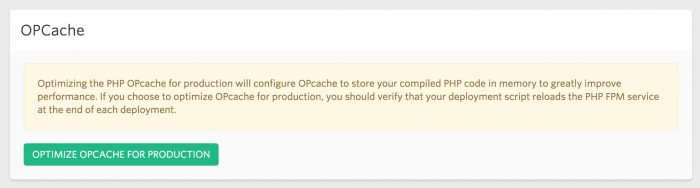
Recently this button to optimize PHP's OPcache was added to Laravel Forge.

If you were wondering what PHP OPcache is all about and what pressing this button does with your application, read this article Olav van Schie wrote on the subject a while ago.

Every time you execute a PHP script, the script needs to be compiled to byte code. OPcache leverages a cache for this bytecode, so the next time the same script is requested, it doesn’t have to recompile it. This can save some precious execution time, and thus make your app faster (and maybe save some server costs).

https://medium.com/appstract/make-your-laravel-app-fly-with-php-opcache-9948db2a5f93

Read more

A tool for making JavaScript code run faster

Even though I'don't like Facebook as a user, their amazing contributions to open source are something to be very grateful for. Last week they presented their new work in progress: Prepack.

Prepack is a tool that optimizes JavaScript source code: Computations that can be done at compile-time instead of run-time get eliminated. Prepack replaces the global code of a JavaScript bundle with equivalent code that is a simple sequence of assignments. This gets rid of most intermediate computations and object allocations.

https://prepack.io/

It's still in development, so best not use it in production environments yet.

Read more

Conditionally pushing event listeners to queue

Mohammed Said, Laravel employee #1 and diver, explains how you can avoid pushing unnecessary jobs to a queue.

How many customers will reach the 10K purchase milestone? does it make sense to push a Job to queue for every single purchase while there's a huge chance that this job will just do nothing at all? IMHO this is a waste of resources, you might end up filling your queue with thousands of unnecessary jobs.

It might be a good thing if we can check for that condition before queueing the listener.

http://themsaid.com/conditionally-queue-listeners-laravel-20170505/

Read more

Moving from PHP (Laravel) to Go

Danny Van Kooten did an interesting experiment. He completely rewrote an Laravel app to a version in Go. In a post on his blog he shares some details about his project along with some benchmarks.

Earlier this year, I made an arguably bad business decision. I decided to rewrite the Laravel application powering Boxzilla in Go.

No regrets though.

Just a few weeks later I was deploying the Go application. Building it was the most fun I had in months, I learned a ton and the end result is a huge improvement over the old application. Better performance, easier deployments and higher test coverage.

https://dannyvankooten.com/laravel-to-golang/

Read more

How we improved our PWA score by 53 points in 4 hours

On the madewithlove blog Frederick Vanbrabant wrote a post on how he and colleague improved the PWA score of their company site.

So the first thing you should know about PWA (or progressive web apps) is that it’s an adaptation of your current site or web app. This means that if you want to have all the features of a progressive web app, you are going to need to change your current site/application. The good news here is that they are all changes you would want to have anyway.

https://blog.madewithlove.be/post/improved_pwa_score

Read more

Symfony Routing performance considerations

On his blog Frank De Jonge explains how he solved a performance problem in one of his projects.

Last week I took a deep dive into Symfony's Routing Component. A project I worked on suffered from a huge performance penalty caused by a routing mistake. This lead me on the path to discovering some interesting performance considerations. Some common practices align nicely with Symfony's optimisations, let's look into those.

https://blog.frankdejonge.nl/symfony-routing-performance-considerations/

Read more

Environment variables, config caching, and Laravel

In a short blogpost Michael Dyrynda gives some good advice on why you should cache your routes and config values.

As part of the recommended production deploy process it is important to run the caching commands that Laravel affords us via Artisan. This means running config:cache and route:cache, which will compile the config and route files down into a single file each.

In doing so, Laravel aims to speed up parsing of these files by only needing to read a single, rather than multiple files.

https://dyrynda.com.au/blog/environment-variables-config-caching-and-laravel

Read more

Getting started with Varnish Cache

If you want to learn Varnish Thijs Feryn wrote a book for you. It's free to download until 7th March 2017.

Getting Strated with Varnish Cache is a technical book about the Varnish caching technology. Varnish is a so-called reverse caching proxy that acts as an intermediary between the browser and the webserver. Varnish stores HTTP responses and serves them to the browser, without accessing the backend for every request. This causes a massive speed increase.

https://blog.feryn.eu/my-varnish-book-is-now-available/

Read more

A checklist for all projects that are going live original

by Freek Van der Herten – 2 minute read

Apart from our open source work, we do client work at Spatie as well. Over the years we've learned that one of the most critical moments of a project is when it is going live. No matter how you confident you are about the correctness of the code base there are so many big and little things that…

Read more

Using Varnish on a Laravel Forge provisioned server original

by Freek Van der Herten – 12 minute read

For a project we're working on at Spatie we're expecting high traffic. That's why we spent some time researching how to improve the request speed of a Laravel application and the amount of requests a single server can handle. There are many strategies and services you can use to speed up a site. In…

Read more

10 things I learned making the fastest site in the world

David Gilbertson made a lighting fast site and wrote a fantastic article about it.

Writing a fast website is like raising a puppy, it requires constancy and consistency (both over time and from everyone involved). You can do a great job keeping everything lean and mean, but if you get sloppy and use an 11 KB library to format a date and let the puppy shit in the bed just one time, you’ve undone a lot of hard work and have some cleaning up to do.

https://hackernoon.com/10-things-i-learned-making-the-fastest-site-in-the-world-18a0e1cdf4a7

Read more

Inside PHP 7's performance improvements

On the Blackfire.io blog Julien Pauli peeks behind the curtains of PHP. In the five part series he explains how you should write your code to make the best use of the internal optimizations present in PHP 7.

This blog series will show you what changed inside the Zend engine between PHP 5 and PHP 7 and will detail how you, as a developer, may effectively use the new internal optimizations. We are taking PHP 5.6 as a comparison basis. Often, it is just a matter of how things are written and presented to the engine. Performance must be taken care of when critical code is written. By changing some little things, you can make the engine perform much faster, often without losing other aspects such as readability or debugging control.

https://blog.blackfire.io/php-7-performance-improvements-packed-arrays.html

Read more