Embracing The Tall Stack with Event Sourcing, an adventure into the unknown
Steve King wrote a nice introduction on how to use our event sourcing package together with Livewire. Cool stuff!
Read more [www.juststeveking.uk]
Steve King wrote a nice introduction on how to use our event sourcing package together with Livewire. Cool stuff!
Read more [www.juststeveking.uk]
– blog.rafter.app - submitted by Josh Larson – Edit
Learn how to track and visualize a chain of queued jobs in Laravel using a custom trait, job middleware, and Laravel Livewire.
Read more [blog.rafter.app]
Join 9,500+ smart developers
Get my monthly newsletter with what I learn from running Spatie, building Oh Dear, and maintaining 300+ open source packages. Practical takes on Laravel, PHP, and AI that you can actually use.
No spam. Unsubscribe anytime. You can also follow me on X.
"I’ve been reading freeks newsletter for a while now, and it’s easily one of my favorite developer newsletters. Freek shares practical, no-nonsense insights from running Spatie, maintaining hundreds of open-source packages, and shipping real products. Every time I get useful Laravel tips, smart tooling advice, always high quality and immediately applicable."
by Freek Van der Herten – 24 minute read – Edit
At Spatie we have a TV screen against the wall that displays a dashboard. This dashboard displays the tasks our team should be working on, important events in the near future, which tasks each of our team members should be working on, what music they are listening to, and so on. Here's what it looks like:
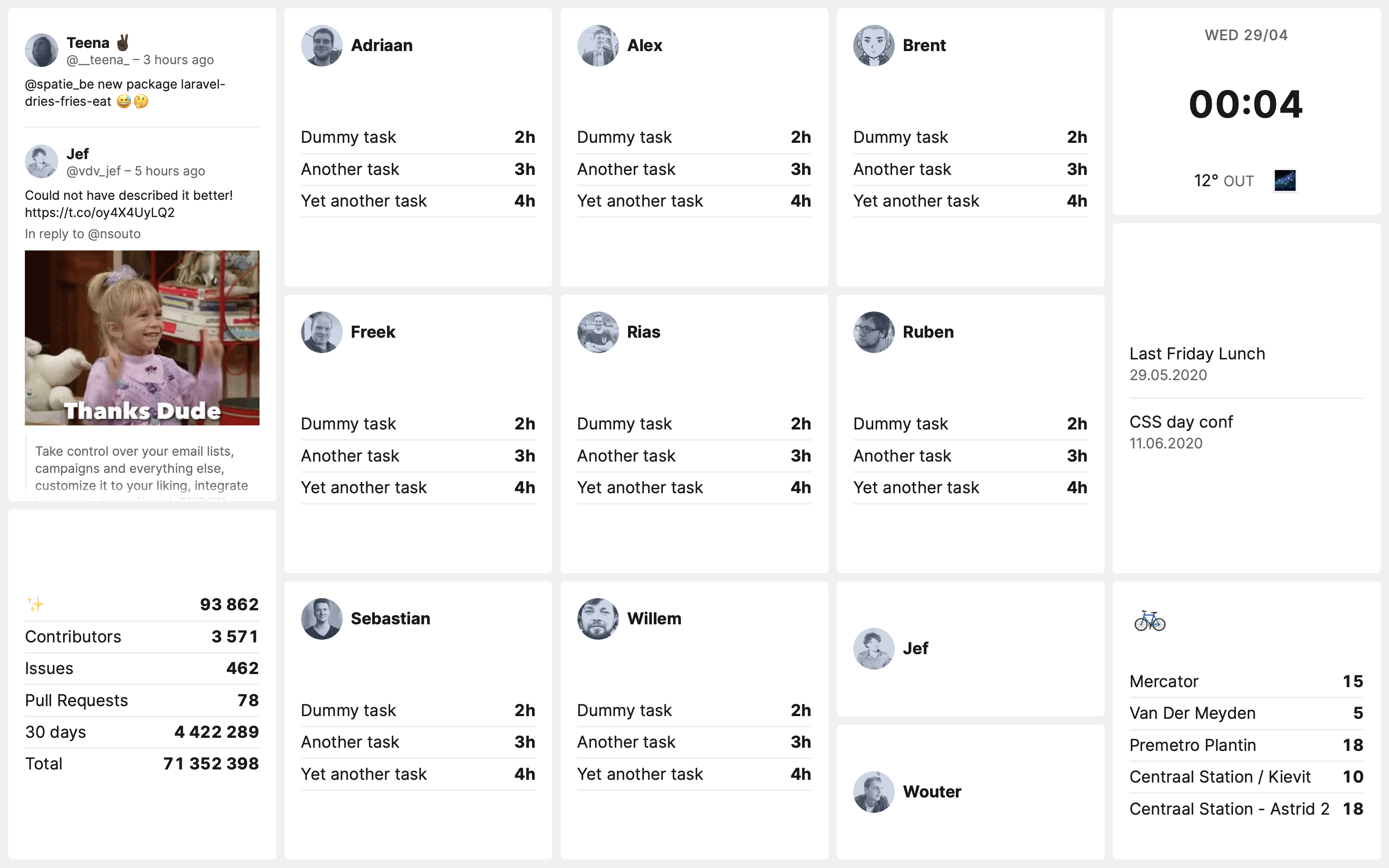
This dashboard is built using our laravel-dashboard package. It will allow you to built a similar dashboard in no time.
In this blogpost I'd like to walk you through both the dashboard and the package.
by Freek Van der Herten – 11 minute read – Edit
Up until a few days ago, the real-time UI of Oh Dear (an uptime monitoring SaaS I run) was powered with web sockets. We recently replaced this with Livewire components.
In this blog post, I'd like to explain why and how we did that.
I'm going to assume that you already know what Livewire is. If not, head over to the Livewire docs. There's even a short video course on there. In short, Livewire enables you to create dynamic UIs using server-rendered partials.
by Freek Van der Herten – 16 minute read – Edit
Together with my buddy Mattias Geniar, I run Oh Dear, an uptime checker service on steroids.
Unlike most uptime trackers, Oh Dear doesn't only check your homepage, but every single page of your site. When we detect a broken link or some mixed content, we send a notification. Oh, and we provide status pages, like this one from Laravel and Flare too.
In this blog post, I'd like to show you how we use Livewire to render some complex forms in the UI of Oh Dear.
Seb De Deyne explains the differences and similarities between Intertia and Livewire.
I’ve seen many people compare the two, or ask if they can be used together. This post showcases their similarities and differences, and should help you understand which problems they each solve best.
Read more [sebastiandedeyne.com]
– calebporzio.com – Edit
Recently status pages were added to Oh Dear!. My colleague Sebastian took care of the live updates with a few lines of JavasScript.
In a new video on his blog Livewire creator Caleb Porzio, shows how can create the same behaviour with Livewire (and without having to write JavaScript). Impressive stuff!
This sort of thing is right up my alley, but I couldn't help but think how easy it would be in Livewire. Here's is the same functionality implemented with Livewire, in three or four little code additions. No JS!
Read more [calebporzio.com]
– calebporzio.com – Edit
Here's a cool video by Caleb Porzio where he demonstrates his proof of concept port of Phoenix LiveView in Laravel.
I recently read through this blog post about Phoenix LiveView and got really excited for what might be possible in Laravel. I started hacking on a little proof of concept in Laravel and quickly realized this might be a game changer.
Read more [calebporzio.com]