Posts tagged with performance

Make your app fly with PHP OPcache

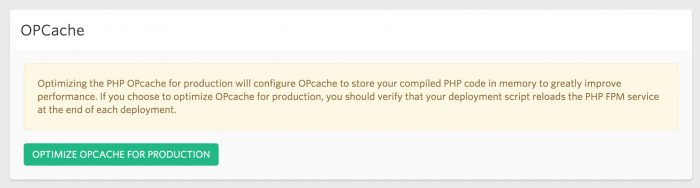
Recently this button to optimize PHP's OPcache was added to Laravel Forge.

If you were wondering what PHP OPcache is all about and what pressing this button does with your application, read this article Olav van Schie wrote on the subject a while ago.

Every time you execute a PHP script, the script needs to be compiled to byte code. OPcache leverages a cache for this bytecode, so the next time the same script is requested, it doesn’t have to recompile it. This can save some precious execution time, and thus make your app faster (and maybe save some server costs).

https://medium.com/appstract/make-your-laravel-app-fly-with-php-opcache-9948db2a5f93

Read more

Join thousands of developers

Every two weeks, I share practical tips, tutorials, and behind-the-scenes insights from maintaining 300+ open source packages.

No spam. Unsubscribe anytime. You can also follow me on X.

A tool for making JavaScript code run faster

Even though I'don't like Facebook as a user, their amazing contributions to open source are something to be very grateful for. Last week they presented their new work in progress: Prepack.

Prepack is a tool that optimizes JavaScript source code: Computations that can be done at compile-time instead of run-time get eliminated. Prepack replaces the global code of a JavaScript bundle with equivalent code that is a simple sequence of assignments. This gets rid of most intermediate computations and object allocations.

https://prepack.io/

It's still in development, so best not use it in production environments yet.

Read more

Conditionally pushing event listeners to queue

Mohammed Said, Laravel employee #1 and diver, explains how you can avoid pushing unnecessary jobs to a queue.

How many customers will reach the 10K purchase milestone? does it make sense to push a Job to queue for every single purchase while there's a huge chance that this job will just do nothing at all? IMHO this is a waste of resources, you might end up filling your queue with thousands of unnecessary jobs.

It might be a good thing if we can check for that condition before queueing the listener.

http://themsaid.com/conditionally-queue-listeners-laravel-20170505/

Read more

Moving from PHP (Laravel) to Go

Danny Van Kooten did an interesting experiment. He completely rewrote an Laravel app to a version in Go. In a post on his blog he shares some details about his project along with some benchmarks.

Earlier this year, I made an arguably bad business decision. I decided to rewrite the Laravel application powering Boxzilla in Go.

No regrets though.

Just a few weeks later I was deploying the Go application. Building it was the most fun I had in months, I learned a ton and the end result is a huge improvement over the old application. Better performance, easier deployments and higher test coverage.

https://dannyvankooten.com/laravel-to-golang/

Read more

How we improved our PWA score by 53 points in 4 hours

On the madewithlove blog Frederick Vanbrabant wrote a post on how he and colleague improved the PWA score of their company site.

So the first thing you should know about PWA (or progressive web apps) is that it’s an adaptation of your current site or web app. This means that if you want to have all the features of a progressive web app, you are going to need to change your current site/application. The good news here is that they are all changes you would want to have anyway.

https://blog.madewithlove.be/post/improved_pwa_score

Read more

Symfony Routing performance considerations

On his blog Frank De Jonge explains how he solved a performance problem in one of his projects.

Last week I took a deep dive into Symfony's Routing Component. A project I worked on suffered from a huge performance penalty caused by a routing mistake. This lead me on the path to discovering some interesting performance considerations. Some common practices align nicely with Symfony's optimisations, let's look into those.

https://blog.frankdejonge.nl/symfony-routing-performance-considerations/

Read more

Environment variables, config caching, and Laravel

In a short blogpost Michael Dyrynda gives some good advice on why you should cache your routes and config values.

As part of the recommended production deploy process it is important to run the caching commands that Laravel affords us via Artisan. This means running config:cache and route:cache, which will compile the config and route files down into a single file each.

In doing so, Laravel aims to speed up parsing of these files by only needing to read a single, rather than multiple files.

https://dyrynda.com.au/blog/environment-variables-config-caching-and-laravel

Read more

Getting started with Varnish Cache

If you want to learn Varnish Thijs Feryn wrote a book for you. It's free to download until 7th March 2017.

Getting Strated with Varnish Cache is a technical book about the Varnish caching technology. Varnish is a so-called reverse caching proxy that acts as an intermediary between the browser and the webserver. Varnish stores HTTP responses and serves them to the browser, without accessing the backend for every request. This causes a massive speed increase.

https://blog.feryn.eu/my-varnish-book-is-now-available/

Read more

A checklist for all projects that are going live

by Freek Van der Herten – 2 minute read

Apart from our open source work, we do client work at Spatie as well. Over the years we've learned that one of the most critical moments of a project is when it is going live. No matter how you confident you are about the correctness of the code base there are so many big and little things that…

Read more

Using Varnish on a Laravel Forge provisioned server

by Freek Van der Herten – 12 minute read

For a project we're working on at Spatie we're expecting high traffic. That's why we spent some time researching how to improve the request speed of a Laravel application and the amount of requests a single server can handle. There are many strategies and services you can use to speed up a site. In…

Read more

10 things I learned making the fastest site in the world

David Gilbertson made a lighting fast site and wrote a fantastic article about it.

Writing a fast website is like raising a puppy, it requires constancy and consistency (both over time and from everyone involved). You can do a great job keeping everything lean and mean, but if you get sloppy and use an 11 KB library to format a date and let the puppy shit in the bed just one time, you’ve undone a lot of hard work and have some cleaning up to do.

https://hackernoon.com/10-things-i-learned-making-the-fastest-site-in-the-world-18a0e1cdf4a7

Read more

Inside PHP 7's performance improvements

On the Blackfire.io blog Julien Pauli peeks behind the curtains of PHP. In the five part series he explains how you should write your code to make the best use of the internal optimizations present in PHP 7.

This blog series will show you what changed inside the Zend engine between PHP 5 and PHP 7 and will detail how you, as a developer, may effectively use the new internal optimizations. We are taking PHP 5.6 as a comparison basis. Often, it is just a matter of how things are written and presented to the engine. Performance must be taken care of when critical code is written. By changing some little things, you can make the engine perform much faster, often without losing other aspects such as readability or debugging control.

https://blog.blackfire.io/php-7-performance-improvements-packed-arrays.html

Read more

Dealing With Templates in Vue.js 2.0

Sebastian De Deyne, my colleague at Spatie, wrote a very nice overview of all different methods in Vue to define a template.

This article isn't about Vue's template syntax, but about where and how to define your templates. I wrote this because at the time of writing there aren't really resources that consolidate all the different manners to manage your templates.

I've divided the different ways to define templates in three different categories, each with their own drawbacks:

  • Writing templates that compile at runtime (lesser performance)
  • Using single file .vue components (requires a build step)
  • Manually writing render functions (pure JavaScript, no html-like template syntax)

https://sebastiandedeyne.com/posts/2016/dealing-with-templates-in-vue-20

Read more

Optimizing PHP performance by using fully-qualified function calls

A fully qualified function name is a little bit faster than a non-qualified one. Toon Verwerft explains it all in his lastest blogpost.

Today, a little conversation on Twitter escalated rather quickly. Apparently PHP runs function calls differently depending on namespaced or non namespaced context. When calling functions in a namespaced context, additional actions are triggered in PHP which result in slower execution. In this article, I'll explain what happens and how you can speed up your application.

http://veewee.github.io/blog/optimizing-php-performance-by-fq-function-calls/

Read more

Improving the performance of our PHP based crawler

by Freek Van der Herten – 2 minute read

Today a new major version of our homegrown crawler was released. The crawler is used to power our http-status-check, laravel-sitemap and laravel-link-checker packages. A new major feature is the greatly improved crawling speed. This was accomplished by leveraging multiple concurrent requests. Let's…

Read more

A full web request may be faster than a SPA

At this years Chrome Dev Summit Jake Archibald gave an excellent talk on some new features that are coming to the service worker. In case you don't know, a service worker is a piece of JavaScript that sits between the network request sent by the JavaScript in your browser and the browser itself. A common use case for a service is to display a custom page when there is no internet connection available instead of showing the default error message in your browser. And of course you can use a service worker to have a high degree of control on how things are cached.

I really like Jake's presentation style in general. He always injects a lot of humour. This time he's presenting in a tuxedo, with no shoes on and he uses a Wii Controller to control his slides. Go Jake!

A very interesting part of the talk is when he touches on the time needed to display a page. Turns out a full web request can be a faster than a fancy single page application. Watch that segment on YouTube by clicking here.

Or you can choose to just watch the whole presentation in the video below.

Read more

PHP 7 at Tumblr

Another big boy on the web upgraded to PHP 7. If you're not yet on the train heading for PHP7-ville, best get your ticket soon, you won't regret it.

At Tumblr, we’re always looking for new ways to improve the performance of the site. This means things like adding caching to heavily used codepaths, testing out new CDN configurations, or upgrading underlying software. Recently, in a cross-team effort, we upgraded our full web server fleet from PHP 5 to PHP 7. The whole upgrade was a fun project with some very cool results, so we wanted to share it with you.

https://engineering.tumblr.com/post/152998126990/php-7-at-tumblr

Read more

A magic memoization function

by Freek Van der Herten – 4 minute read

Last friday Taylor Otwell tweeted an easy to use memoization function called once: Wanted a slick way to generalize class method memoization. Y'all don't even want to know how it works. ? ? pic.twitter.com/xRJAY1C14y— Taylor Otwell (@taylorotwell) November 4, 2016 Taylor was kind…

Read more

Varnish explained

Varnish is a piece of software that, amongst other things, can make your website much faster. In a new post on his blog, Mattias Geniar tells you all about it.

Varnish can do a lot of things, but it's mostly known as a reverse HTTP proxy. It brands itself as an HTTP accelerator, making HTTP requests faster by caching them. ... Varnish is usually associated with performance, but it greatly increases your options to scale your infrastructure (load balancing, failover backends etc) and adds a security layer right out of the box: you can easily let Varnish protect you from the httpoxy vulnerability or slowloris type attacks.

https://ma.ttias.be/varnish-explained/

Be sure to watch Mattias' excellent talk he gave at this years Laracon:

Read more