Why we are sponsering our local user group original

by Freek Van der Herten – 3 minute read

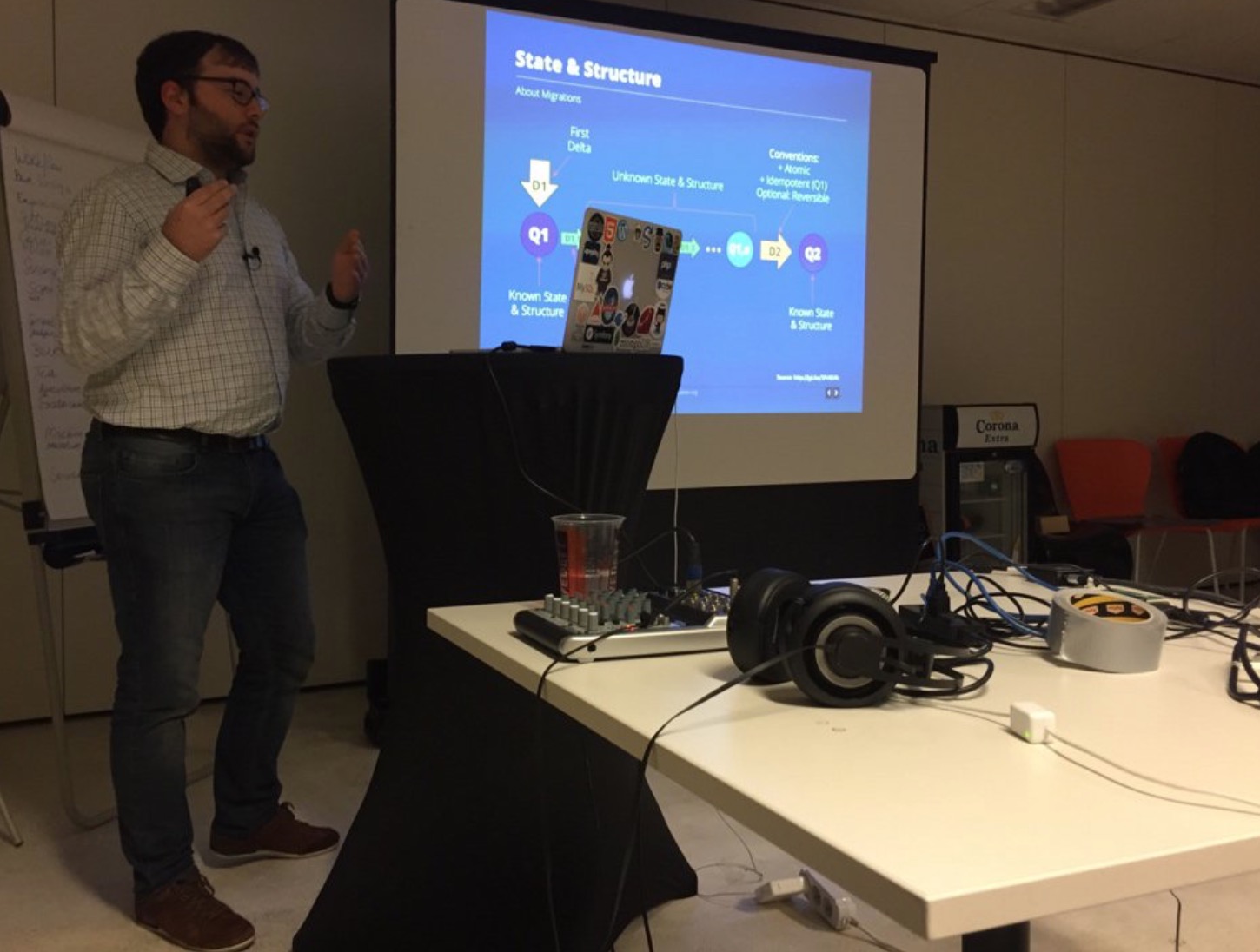
At the end of this month our local user group, PHP Antwerp, will hold it's third meetup. It'll be sponsered by Spatie, of which I'm a co-owner. In this post I'd like to explain why we are sponsering this event. Of course as a company it's good to get our name out there but there are other more…

Read more

Join 9,500+ smart developers

Get my monthly newsletter with what I learn from running Spatie, building Oh Dear, and maintaining 300+ open source packages. Practical takes on Laravel, PHP, and AI that you can actually use.

No spam. Unsubscribe anytime. You can also follow me on X.

The innovation slider

Konstantin Kudryashov shares some thoughts on the relation between predictability and innovation.

Every time I meet a client to discuss their new project plans, I encounter the same question: "I want my software to be unique and different. How much will it cost?” The problem is that unique products and true innovation are difficult to estimate, and even harder to accurately budget for. Helping a business find the balance between the innovation they need, and the predictability they want led me to create the Innovation Slider, a tool you can use to harmonise the split between innovation and predictability in software projects.
http://stakeholderwhisperer.com/posts/2016/1/innovation-slider

Read more

Say goodbye to manually creating a robots.txt file original

by Freek Van der Herten – 1 minute read

If you don't want a site to be indexed by search engines you must place a robots.txt file. Typically you don't want anything indexed except production sites. Today Spatie released a new package called laravel-robots-middleware. It was coded up by my colleague Sebastian. Instead of you having to…

Read more

Why we are requiring PHP 7 for our new packages

The past few weeks we released several new packages: laravel-sluggable, laravel-robots-middleware, laravel-glide and pdf-to-text. These packages have in common that they all require PHP 7. Because there were several reactions and questions about this, I'd like to shed some light on that decision.

I expect that lots of developers will make the move to PHP 7 in the coming year. Sure there will always be legacy projects that'll never see an upgrade, but it makes no sense starting a greenfield project in PHP 5.X. The performance benefits are just too good. On the package side I expect that some widely used packages will make the jump as well. Jordi Boggiano has already announced that the next version of Monolog targets PHP 7. Also keep in mind that active support for PHP 5.x is coming to end this August (or at the latest December).

Not only developers will make a quick move to PHP 7. The speed benefit is quite interesting for hosting companies as well. A speedier PHP version means a machine can host more sites. There quite a few hosting companies that already made the jump and are offering PHP 7 support.

When we work on projects at Spatie we have to solve a lot of problems. When we solve a problem in way that the solution can be used in future projects, we create a package. So we create these packages primarily for our own future projects. We decided that from now on every greenfield project wil be a PHP 7 one. So it makes sense that our new packages would require PHP 7 as well. By doing so we can make use of the latest new features such as the scalar type hints, return types, anonymous classes and the null coalescing operator. At some point all our projects will leave PHP 5.6 behind. The earlier we won't have to deal with PHP 5.X code anymore the better.

I'm well aware that requiring PHP 7 will hurt the popularity of our packages in the short run. But popularity is not our main goal. People who are using the latest and greatest version of PHP can benefit from our work. And I hope others will be nudged a bit towards PHP 7 by our decision.

(EDIT: we won't change the requirements of our older packages. PHP 7 will only be required when we create a new major version.)

Read more

A package to extract text from a pdf original

by Freek Van der Herten – 1 minute read

For a project I needed to extract some text from a pdf. Although there were already a few packages that could to this, I still created spatie/pdf-to-text because I wanted something that was really easy to use. And also because it's fun creating packages. Under the hood a utility called pdftotext is…

Read more

A beginner’s guide to information architecture

... information architecture is the creation of a structure for a website, application, or other project, that allows us to understand where we are as users, and where the information we want is in relation to our position. Information architecture results in the creation of site maps, hierarchies, categorizations, navigation, and metadata.

Information architecture is a task often shared by designers, developers, and content strategists. But regardless of who takes on the task, IA is a field of its own, with influences, tools, and resources that are worth investigation. In this article we’ll discuss what information architecture really is, and why it’s a valuable aspect of the user experience process.

http://www.uxbooth.com/articles/complete-beginners-guide-to-information-architecture/

Read more

Starting a newsletter original

by Freek Van der Herten – 1 minute read

I decided to add a newsletter to my blog. The plan is to send out a newsletter every two weeks. Newsletters will contain lots of interesting stuff for the modern PHP developer. You can expect quick tips, links to interesting tutorials, opinions and packages. Because I work with Laravel every day…

Read more

Vim for beginners

Last year I made myself a bit acquainted with Vim. I'm by no means an expert and am not (yet :-)) advocating to replace your favourite IDE with Vim. I use it for small things:

  • it's much easier/faster to to edit files on a server using Vim as opposed to opening and editing the files in a tool like Transmit. There's a big chance that vim is already installed on your server.
  • editing your hostfile is breeze with vim.
  • if you need a small change, like deleting a line, in a file and you're IDE isn't open, Vim can help you.
  • there's a big change that you already use Vim when Git promts you to specify a commit message
Unlike most pieces of software, Vim has absolutely no respect for the beginner. Even quitting it proves quite difficult. There's really nobody that can use Vim without some training. But with same quick pointers everybody can do the tasks mentioned above.

Watch this video clearly explains the basic commands.

https://www.youtube.com/watch?v=Nim4_f5QUxA

Read more

How to become a great engineer

Philip Walton, an engineer at Google, wrote a wonderful article that every developer should read. He talks about front-end engineers, but most tips are applicable to back-end engineers as well. A few quotes:

Taking the time to figure out why your hack works may seem costly now, but I promise it’ll save you time in the future. Having a fuller understanding of the systems you’re working within will mean less guess-and-check work going forward.
Solving problems on your own is a great way to learn, but if that’s all you ever do, you’ll plateau pretty quickly. Reading other people’s code opens your mind to new ways of doing things.
In my experience, writing, giving talks, and creating demos has been one of the best ways to force myself to dive in and fully understand something, inside and out. Even if no one ever reads what you write, the process of doing it is more than worth it.
Be sure to read the full article here: http://philipwalton.com/articles/how-to-become-a-great-front-end-engineer/

Read more

Easily convert images with Glide

Glide is an easy to use image manipulation library by Jonathan Reinink. It was bumped to version 1.0.0 a few days ago. Glide can created optimized images on the fly by levering url's such as /img/users/1.jpg?w=300&h=400&fit=crop. Take a look at the example in the Glide documentation to know more.

I think Glide provides a very nice API to create image manipulations. Unfortunately it isn't very easy to use the API to generate an image using code. So I created a little package for that called laravel-glide. All new major versions of Spatie packages will require PHP 7, laravel-glide is no exception to this.

Here's an example of how to create a greyscale version image with a maximum width of 50 pixels.

GlideImage::create($pathToImage)
    ->modify(['filt'=>'greyscale', 'w'=> 50])
    ->save($pathToWhereToSaveTheManipulatedImage);

Take a look at Glide's image API to see which parameters you can pass to the modify-method.

Read more

The Road to Monolog 2.0

One of the main questions when doing a major release is which minimum PHP version to support going forward. Last summer I decided I wanted to do a big jump from 5.3 and directly target PHP 7. It provides a lot of nice features as well as performance improvements, and as Monolog is one of the most installed packages on Packagist I wanted to help nudge everyone towards PHP 7.
http://seld.be/notes/the-road-to-monolog-2-0

Read more

Shaping your technical patterns based on your organizational patterns

Most outlets of technical information (whether high profile developers, companies, etc…) focus on architectural patterns and there’s never any talk about organizational patterns. In other words, does the architectural pattern that you choose fit your organizational pattern?
http://eli4d.com/2015/12/23/fullstack-radio-podcast-episode-with-dhh-shaping-your-technical-patterns-based-on-your-organizational-patterns/

Read more

A PHP 7 / Laravel package to create slugs original

by Freek Van der Herten – 2 minute read

Spatie, the company where I work, recently released a Laravel package called laravel-sluggable. It automatically creates unique slugs when saving a model. To install the package you just need to put the provided Spatie\Sluggable\HasSlug-trait on all models that have slugs. The trait contains an…

Read more

Converting big PHP codebases to PSR-2

It is known by now that every codebase large enough (in terms of lines of code or people collaborating to it) should follow any code standard. Here at Coolblue we weren’t different and were using our own coding standard.

But codebases evolve. And our codebase – that has been supporting one of the most visited ecommerces in The Netherlands – needed to be upgraded to a coding standard that’s a little bit more up to date.

This is the process we follow to move into PSR-2.

http://devblog.coolblue.nl/tech/converting-big-php-codebases-to-psr2/

In the past months we converted several of our old projects to PSR-2 with Fabien Potencier's coding standards fixer and had zero issues doing so. Hurray for standardized code.


Read more

Using collection macros in Laravel

Laravel 5.2 provides some nice additions to the framework. One handy feature that I don't see listed in the release notes is that Collection now is macroable. Using it's macro function you can easily extend Illuminate\Support\Collection with your own custom functions.

Take a look at this piece of code to uppercase every string in a collection.

$uppercaseWords = collect(['code', 'ferengi'])->map(function($word)  {
   return strtoupper($word);
});

That's good code, but image you need to uppercase a lot of collections. Typing the same closure will get very tiresome. Let's improve this with a macro.

use Illuminate\Support\Collection;

Collection::macro('uppercase', function() {

    return collect($this->items)->map(function($word) {
        return strtoupper($word);
    });

});

You could create a service provider to load up these macro's. Now that the macro is defined let's uppercase collections like there's no tomorrow:

$uppercaseWords = collect(['code', 'ferengi'])->uppercase();
$moreUppercaseWords = collect(['love', 'the', 'facade'])->uppercase();
$evenMoreUppercaseWords = collect(['activerecord', 'forever'])->uppercase();

You could be thinking "Why should I use a macro? I can easily to this with a regular function.". Consider this piece of code.

function uppercase($collection) {
...
}

$uppercaseWords = uppercase(collect(['halo','five']));

It works, but you have to encapsulate the collection with your function. The last executed function is put first, which is confusing. With macro's you can still chain functions and greatly improve readability.

//lots of functions
function4(function3(function2(function1(collect(['jack','cheats'])))));

//lots of macros
collect(['i', 'want', 'to', 'live', 'in', 'a', 'desert'])
  ->function1()
  ->function2()
  ->function3()
  ->function4();

Sure, the examples use in this post were a bit contrived, but I hope you see that collection macro's can be very handy.

EDIT: it seems that collection macro's were introduced in Laravel 5.1.25 a month ago.

Read more

What web developers should know about SSL but probably don't

In 2015 web developers understand more about SSL than they ever have. If you read Hacker News you should know: What about the rest?
https://certsimple.com/blog/obsolete-cipher-suite-and-things-web-developers-should-know-about-ssl

Read more